
I’d been rehearsing casual for three weeks.
Not obsessively. Reasonably. The specific register I was practicing was not too eager, not too indifferent — a person who has moved on, who reorganized around the loss of a particular friendship the way you reorganize a room after the furniture changes, and who now exists, quite stably, in the new arrangement. I’d been practicing it in the shower and on the subway and once, embarrassingly, in front of my bathroom mirror at 11pm. I almost believed it. That’s not nothing.
The Uber driver dropped me two blocks away, thanks to festival street closures, which meant I arrived at Joshua’s building already sweating through my good shirt. I stood on the sidewalk for a moment looking up at the building — four floors, bay windows, a buzzer panel with small handwritten labels. 4C. I pressed the button.
The intercom crackled with his voice. “Caleb!”
“Hey. It’s me. I’m here.”
“Obviously you’re here. Come up.”
My stomach dropped.
I told myself it was nerves. I carried the explanation upstairs because it was reasonable, and I was a reasonable person having a reasonable reaction to seeing an old friend after six years.
The explanation didn’t hold. My body had already decided this was something else.
The door buzzed, and I pushed through before I could talk myself into walking back into the September heat and pretending I’d missed my flight.
Four flights. I took the stairs because the elevator looked ancient and slow, and I needed the extra thirty seconds to get my face under control. Thirty seconds to remind myself that Joshua Hale was not, in fact, the gravitational center of the universe. He was just a guy I’d lived with for four years of college, and whatever I’d felt back then—whatever inconvenient, persistent thing I’d carried around like a stone in my chest—that was ancient history.
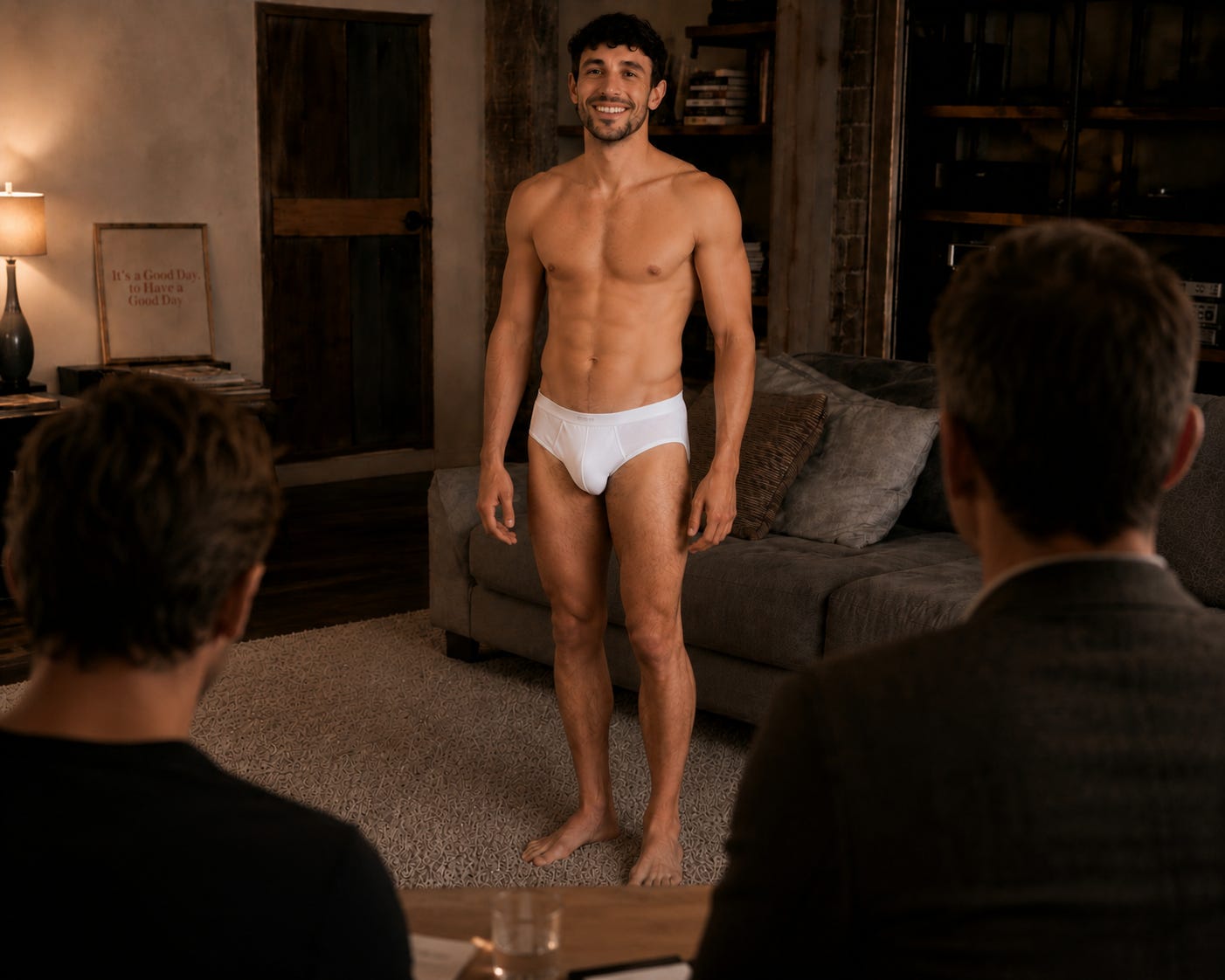
He was waiting in the doorway, and this was the part I’d miscalculated. I’d prepared for seeing him — for the recognition, for the inventory — but I hadn’t fully accounted for the doorway itself. The specific geometry of Joshua filling a frame. He was broader through the shoulders than he’d been in college, the same dark mussed hair, a close-trimmed beard he’d apparently acquired in the last six years. And he was barefoot — immediately, constitutionally barefoot, the way he’d always been, taking his shoes off the moment he crossed any threshold since freshman year, as if the floors of whatever space he entered were his to claim.
Something in my chest did a thing I wasn’t going to examine.
“You look exactly the same,” he said, tilting his head. The sideways not-quite-smile. Everything I’d rehearsed went somewhere I couldn’t locate.
“That’s probably not a compliment.”
“It absolutely is.” He pulled me into a hug, quick and warm and familiar, and the smell of him hit me all at once — detergent, skin, something faintly cedar-like underneath it. My body recognized it before the rest of me did. For a second I was back in our dorm room at 1am. Him asleep shirtless on top of the blankets. Me staring at the ceiling trying not to look at him.
He took my bag from my shoulder — not offering, just taking, like there was no question — and turned back into the apartment. I followed, past the coatrack with its tangle of jackets, into the warm amber smell of garlic and something in the oven.
The apartment looked like two people had been living in it long enough to stop performing for it. I noticed this before I noticed anything else — the illustrator’s reflex, read the space before the figures. Joshua’s bookshelves organized with the aggression of someone who cares but won’t say so. A lamp that was clearly Oliver’s — warm terracotta, actual aesthetic intention. Climbing gear in the corner. The couch slightly sprung, the kind that holds the shapes of two specific people.
This is his life, I told myself. He exists here in a context that has nothing to do with you.
“Oliver’s almost done,” Joshua said, crossing toward the kitchen.
And then the person in the kitchen said my name.
He said it with his back still to us. Then he turned around, wiping his hands on a dish towel, and crossed toward me.
Oliver Bennett was shorter than Joshua by a couple of inches, leaner, tousled blondish/brown hair, blue eyes that found available light the way water finds level. His hands were rough at the knuckles, nicked in several places — the hands of someone whose work pushed back. He moved with an ease in his own body that I clocked before I meant to, the unhurried quality of someone entirely at home in their own skin. He put out his hand and I shook it.
“I’ve heard a lot about you,” he said.
“Good things, I hope.”
“Specific things.” A slight smile. “There’s a difference.”
I wasn’t sure what to do with that, so I didn’t do anything but smile.
“I looked up your work,” he said.
I looked at him. “You did?”
“Of course.” He said it like it was obvious. Like looking up a stranger’s portfolio was a normal thing to do. “The piece with the two figures on the bridge. I kept coming back to it.” A beat. “The distance between them — you can’t tell if they’re about to meet or if they’ve already said goodbye.”
The accuracy of it hit harder than I wanted.
“It’s open to interpretation,” I said.
“That’s what all the best artists say.”
He smiled, and the smile was warm and it landed on me with a specificity that made me want to glance behind me to check he meant me. Oliver Bennett had apparently formed a favorable impression of me before I walked through the door and that this made me nervous in a way I couldn’t cleanly account for. I looked back at my beer.
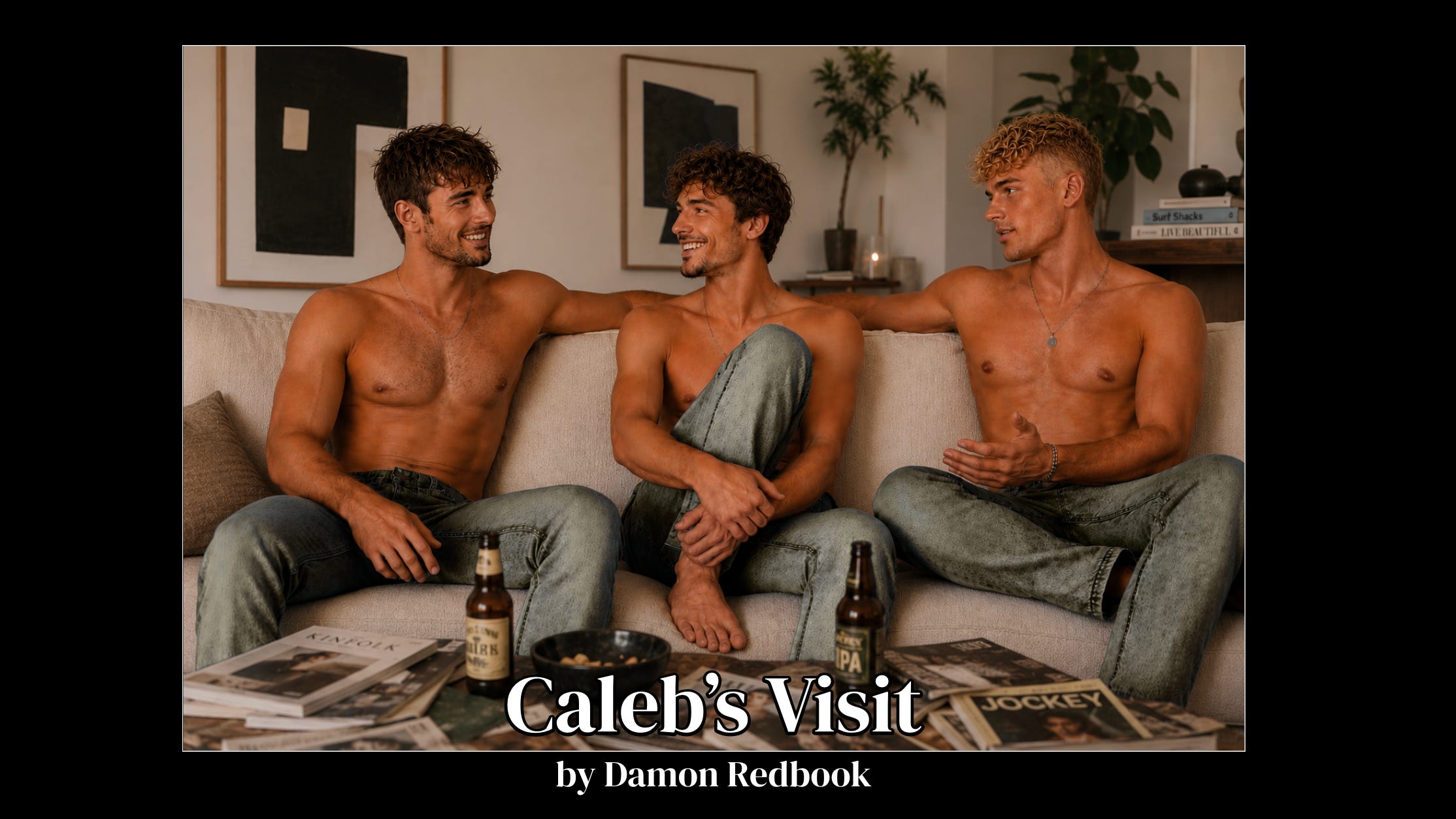
Joshua produced, from the back of the refrigerator a six-pack of Trillium Cutting Tiles — which I had drunk almost exclusively the fall of junior year and not thought about since.
He set them on the counter, opened one, handed it across. Our fingers brushed in the handoff. I didn’t examine whether it was deliberate.
“He mentioned the brand twice,” Oliver said, from behind Joshua, with the warmth of someone who had been living with this quality for years and loved it anyway. “I think he was hoping you’d notice.”
“I notice,” I said.
Joshua shrugged with an expression that meant he was pleased and intended to pretend he wasn’t. I recognized it. I’d forgotten I recognized it. The Trillium was cold and sharp and tasted like a Tuesday in November, junior year, and I took a long drink and set it down.
“I almost got gummy worms and a Dr Pepper,” Joshua said, casually, already turning back to the stove. “Saw them in the store and thought about it for a second. Figured that was too much.”
I went still.
He said it like it was nothing. Like standing in a bodega six years later and picking up a bag of gummy worms on instinct was just a funny thing that had briefly occurred. Not an admission. Just: I remembered, I almost acted on it, I put them back, moving on.
“Probably,” I said.
Oliver was watching me from across the kitchen with an expression that wasn’t quite a smile. I looked at my beer.
The gummy worms had been a thing in college. Not a romantic thing — a Joshua thing, its own category entirely. The night before a big project was due, I’d go quiet in a specific way, too far inside my own head to come out through normal conversation. I’d stopped trying to explain it and just accepted that I went somewhere unreachable the night before work was due. Joshua noticed. I don’t know exactly when — late freshman year, maybe, or sophomore — but at some point he started showing up. Two in the morning, knock on my studio door, a bodega bag swinging from his hand: gummy worms and Dr Pepper because they were my favorites, no explanation beyond you looked like you needed these. He didn’t stay long. He wasn’t performing comfort. He’d assessed the situation, identified what was needed, acted on it, and left me to work.
I’d never asked him to. He’d never asked if I wanted him to. He just showed up, because he’d noticed, and he did something with what he noticed, and then he turned back to whatever he’d been doing before.
I felt gratitude, and underneath the gratitude something that didn’t have a clean name — the particular ache of being known that specifically by someone who had then disappeared for six years, and who was now standing at a stove in Brooklyn producing it all again, casually, like no time had passed.
Joshua had always moved through closeness like it was harmless. Physical affection, late-night confessions, sleeping half on top of people during movie nights, remembering details no one else remembered. He generated intimacy the way some people generated warmth. I had never figured out whether he understood what it did to the people around him.
Joshua turned back from the stove. He looked at me for a moment — a half-second longer than casual — something in his expression that I couldn’t read and that he didn’t offer any key to. He’d been doing that as long as I’d known him. Like there was another step we’d never taken, or another door we’d never opened. Every time I thought I understood what I meant to Joshua, something happened that made the interpretation unstable again. He loved in ways that felt intimate without ever clarifying intimacy. Then he looked away.
We settled in the living room while Oliver finished at the stove — Joshua on the couch, me on the floor with my back against the coffee table, the way I’d always preferred. The Trillium was cold in my hand.
Joshua stretched against the back of the couch, his shirt lifting just enough to expose the flat line of his stomach. Something low in my body tightened before I could stop it.
So not cool.
“I looked you up too,” I said, turning toward the kitchen. “Oliver Bennett Sculptor. Which is a very literal Instagram name.”
“Joshua named it.”
Joshua, from the couch, rolled his eyes: “I did not choose the name, told him to make it something people could find.”
Oliver appeared in the kitchen doorway, dish towel over his shoulder. “The reach piece,” I said, before I could stop myself. “The arm extended. I kept trying to figure out what it was reaching for.”
He went slightly still. Not caught — the stillness of someone encountering something true from an unexpected direction.
“I don’t know yet,” he said. “That’s the part I’m still working on.”
“I figured. It looked like it.”
A beat of quiet.
“He does that,” Joshua said, looking at me. “Makes the thing before he knows what it’s about and figures it out after. I’ve watched him finish a piece, step back, and genuinely have no idea what he’s just made. Then three weeks later he explains it like it was always obvious.”
“It usually is obvious,” Oliver said. “After.”
“High praise,” Joshua said drily. Then, with a turn of his head: “You do the same thing. In your work. The ambiguity isn’t evasion — it’s structural.”
I looked at him. He said it the way you say something you’ve been thinking for a while and finally just say, with no particular ceremony.
“Yeah,” I said. “That’s — yeah.”
Held my gaze for a moment, something moving in his expression that I couldn’t name. Then he looked down. Just like that.
I looked at my beer.
A beat passed. Then Joshua said: “Oliver got obsessed with Murnau last winter. Watched Sunrise four times in one week.”
“Sunrise is the one where the problem of cinema gets solved in eight seconds.”
Oliver appeared in the kitchen doorway. He looked at me for a moment with that quality of attention — the question being checked against the answer. Then he smiled, came in, and sat cross-legged beside me.
We talked about Murnau — or I talked and Oliver pushed back in the specific way of someone who has thought about it more than casually, and somewhere in that exchange I forgot to manage myself.
Joshua got up to check on the bread, and as he went he was already singing — mid-verse, fully committed, badly. “A little ditty about Jack and Diane/ Two American kids doin the best they can.” I went completely still.
“He still does that?” I said, toward Oliver in the armchair.
His laugh — that genuinely good laugh, starting low. “Every day. Sometimes twice.”
“He doesn’t know he’s bad.”
“He absolutely does not know he’s bad.”
We were both grinning — a brief, genuine moment that belonged entirely to us — and when Joshua came back he looked between us with actual uncertainty. “Were you just complimenting my singing?”
He meant it. That was the funniest part. Oliver caught my eye with an expression I didn’t entirely understand — warm, yes, but carrying something else underneath, a charge I couldn’t name that landed low in my stomach. I looked away.
Dinner was made. Oliver brought it out in bowls and we ate on the floor around the coffee table, the city outside the window going amber and then blue. The conversation continued the way it had been going — Murnau giving way to Renoir, giving way to a genuine argument about whether the French New Wave had saved or ruined cinema. I was warm and engaged and slightly combative, the version of myself that exists when I’m not afraid of anything in the room.
Joshua was nearby, reclining against the couch. I was aware of him the way you’re aware of a fire — not looking directly, always knowing exactly where it was.
“You used to do this in the library,” Joshua said, without looking up.
I stopped. “Do what?”
“Get like this about a film. You’d find whoever had seen it and corner them. You did it to me about Chinatown for forty-five minutes freshman year.”
“I don’t remember that.”
“You absolutely remember that. You had a thesis. There were diagrams.”
“There were no diagrams.”
“There was a napkin.”
Oliver was watching us with the quality of attention I was starting to recognize as his resting state — warm, precise, missing nothing.
“I had notes,” I said.
“Diagrams,” Joshua said, and the corner of his mouth did the thing, and he looked away.
Oliver caught my eye across the room. His expression was warm and careful and holding something I couldn’t quite read — something that went beyond cataloging, that had a temperature to it. It lasted a beat too long. Something dropped in my chest, lower than I expected, and I looked away before I could identify what it was or what he’d meant by it.
The conversation moved the way it moves when people are comfortable — around corners, doubling back, going nowhere with purpose.
At some point during the second glass of wine Joshua’s hand found Oliver’s thigh. Automatic, unconscious, the gesture of someone who has stopped keeping track of whether he’s allowed to touch. Not performed for anyone.
I saw it and looked away. Looked at my bowl. Looked back.
Jealousy, I told myself. Simple, accountable jealousy. The predictable response to watching someone you’d once wanted touch someone he’d chosen instead. I could work with jealousy.
What I couldn’t quite work with was the way my eye kept returning to the point of contact — Joshua’s hand, Oliver’s leg — and the specific quality of warmth that gathered there. That was something other than jealousy, something I didn’t have a tidy category for, and I took another drink and left it uncategorized.
A little later — bowls half-empty, the second bottle open — I glanced across the coffee table and saw that Joshua’s bare foot had found Oliver’s calf. Just resting there, the top of his foot warm against Oliver’s leg, the way you touch someone when you’ve stopped counting your own touches.
Something moved through me. Warm, immediate, physical — pressure building at my groin before I’d even registered what I was looking at. I looked back at my wine. My pulse was doing something I needed it to stop doing. I was acutely aware of being on the floor in a small warm room with these two men, the lamplight close, the three of us near enough that I could feel the warmth coming off Joshua’s arm.
I shifted, angling my hips away, and held my wine glass in my lap with both hands.
The bulge in my pants was growing. Joshua was two feet away. If he glanced over — if he glanced down — he would see exactly what had happened to me, and I had no explanation that didn’t unravel everything I’d spent three weeks rehearsing. I focused on Oliver, who was saying something about the wine. I kept my eyes off the foot. I waited, with what remained of my dignity, for my body to come back under management.
There is more to this chapter, but it is too long for LPSG, so you can read it in full here:
: Redbook | Substack