

You are using an out of date browser. It may not display this or other websites correctly.
You should upgrade or use an alternative browser.
You should upgrade or use an alternative browser.
Random thoughts
- Thread starter D_Barbi_Queue
- Start date


rbkwp
Mythical Member
- Joined
- Aug 21, 2007
- Posts
- 93,221
- Media
- 1
- Likes
- 52,852
- Points
- 608
- Location
- Auckland, Auckland, NZ
- Sexuality
- 100% Gay, 0% Straight
- Gender
- Male
dont think anyones really caring
world just feels obliged to bring it up every 6 months
wait till they really dissapear then everyone will shit themselves
Bees are dying. What can we do about it?
Social media is abuzz with photos of bees drinking sugar water from teaspoons, after a post on a fan page dedicated to the British naturalist Sir David Attenborough draws attention to the dwindling population of bees worldwide.
![]()
Email
Bees are dying. What can we do about it?
The Signal
By Stephen Smiley
Updated June 25, 2018 06:30:02
![]() PHOTO: Experts warn neonicotinoids on crops and rising global temperatures are impacting bee populations. (AAP)
PHOTO: Experts warn neonicotinoids on crops and rising global temperatures are impacting bee populations. (AAP)
MAP: Australia
Social media is abuzz with photos of bees drinking sugar water from teaspoons, after a post on a fan page dedicated to British naturalist Sir David Attenborough drew attention to the dwindling population of bees worldwide.
External Link: Courtney Flannagan tweet
Since 2013, bee populations in some parts of the world have fallen by a third, with phenomena ranging from the spread of the varroa mite to climate change identified for blame.
In Australia, researchers and authorities say local bee populations remain resilient, but in Europe, Asia, North America and even New Zealand, it is a different story.
In a widely-shared post on Facebook that has inspired hashtag #savethebees, the Attenborough fan page warned the disappearance of bees would spell the end of humanity within four years.
"If bees were to disappear from the face of the earth, humans would have just four years left to live," it said.
"If you find a tired bee in your home, a simple solution of sugar and water will help revive an exhausted bee.
"Simply mix two tablespoons of white, granulated sugar with one tablespoon of water, and place on a spoon for the bee to reach."
Plant plants, avoid pesticides
In Australia, amateur beekeepers say the suggestion about sugar water to help bees in distress is sound.
The best things Australians can do to support bees are to plant flowering plants in their gardens, and to support bee colonies when they are swarming in search of a hive, the Amateur Beekeepers Association's Nathan Organ told the ABC's daily podcast The Signal.
"The suburbs are a great place for bees, and that's where backyard gardeners are important, in terms of their use of pesticides and that sort of stuff," he told The Signal.
"If our urban gardens are pesticide free, then our urban honey will have fewer pesticides in it, and the bees will benefit.
"The best thing Australians can do is to plant plants — not necessarily native plants, but plants that the bees love — so typically, blues, yellows and oranges — they're the favourite colours of bees."
Bees 'our modern-day canaries in the coal-mine'
External Link: Chiara Guarino tweet
The reasons behind the progressive disappearance of bees in most other countries are complex, but bee enthusiast and eco-stress physiologist Dr Reese Halter said the use of neonicotinoids on crops, rising average temperatures globally and the spread of the varroa mite — which causes deformed wing virus in bees — were the principal causes.
Dr Halter said a decision by the European Union to phase out the use of neonicotinoids in all cases except in greenhouses by the end of this year was a good way to try to help global bee populations recover.
He urged the US and Australian governments to follow suit.
"This is a crisis of epic proportions, and we need lawmakers to make laws so that we can protect our only home," he said.
"Bees are our modern-day canaries in the coal mine. In excess of 336,000 types of plants are pollinated by bees, and the bees contributed to 75 per cent of our food crops.
"We need to make some very serious changes in the next five or six years, because we can't lose these bees."
The Australian Pesticides and Veterinary Medicines Authority, which regulates agricultural and veterinary chemical products in Australia, has been monitoring the European decision on neonicotinoids.
It has no plans to implement a similar ban in Australia at this stage, but said on its website it will "continue to monitor and assess new information and credible scientific reports as they become available".
It also said the problem of declining bee populations in Europe is a "complex issue" that involves "the interaction of many factors in addition to pesticide use, such as nutrition, environment and disease, that are not of concern to Australia's bee population".
'Sentinel hives': Australia's bee frontline
The frontline in Australia's battle to avoid the problems that beset bee populations in most other parts of the world is a network of what are termed "sentinel hives", positioned around the country's major sea ports.
Justine Crawford oversees around a dozen such hives around Port Botany in Sydney, and about seven at Port Kembla, south of Wollongong.
She said containers arriving in Australia from ports overseas sometimes contain bees that have set up colonies inside.
"If you think about the millions of containers in ports worldwide, they sit there for months, and for bees it's one of the best places to build a home," she said.
"I call them 'Houdinis' — they actually can find their way into the tiniest little spaces and make it home."
Ms Crawford said she uses a sticky mat placed in the hives to collect samples from each of the colonies, which are then sent to the New South Wales Department of Primary Industries for analysis.
She said, once any abnormalities are detected — including the presence of the deadly varroa mite, bees in all the known colonies in the surrounding area are exterminated to try to contain the spread.
"If they find anything, they'll phone us straight away, and then it's a matter of every single beehive within a 20 kilometre radius being shut down," she said.
Justine Crawford said, while the system as it operates is rigorous, she fears it is only a matter of time before the diseases that have destroyed bee populations overseas arrive in Australia.
"If you read all the reports, they're all saying: 'It will happen, they will get here'," she said.
"It's just a matter of when — not if, but when."
Bees are dying. What can we do about it?
world just feels obliged to bring it up every 6 months
wait till they really dissapear then everyone will shit themselves
Bees are dying. What can we do about it?
Social media is abuzz with photos of bees drinking sugar water from teaspoons, after a post on a fan page dedicated to the British naturalist Sir David Attenborough draws attention to the dwindling population of bees worldwide.

Bees are dying. What can we do about it?
The Signal
By Stephen Smiley
Updated June 25, 2018 06:30:02

MAP: Australia
Social media is abuzz with photos of bees drinking sugar water from teaspoons, after a post on a fan page dedicated to British naturalist Sir David Attenborough drew attention to the dwindling population of bees worldwide.
External Link: Courtney Flannagan tweet
Since 2013, bee populations in some parts of the world have fallen by a third, with phenomena ranging from the spread of the varroa mite to climate change identified for blame.
In Australia, researchers and authorities say local bee populations remain resilient, but in Europe, Asia, North America and even New Zealand, it is a different story.
In a widely-shared post on Facebook that has inspired hashtag #savethebees, the Attenborough fan page warned the disappearance of bees would spell the end of humanity within four years.
"If bees were to disappear from the face of the earth, humans would have just four years left to live," it said.
"If you find a tired bee in your home, a simple solution of sugar and water will help revive an exhausted bee.
"Simply mix two tablespoons of white, granulated sugar with one tablespoon of water, and place on a spoon for the bee to reach."
Plant plants, avoid pesticides
In Australia, amateur beekeepers say the suggestion about sugar water to help bees in distress is sound.
The best things Australians can do to support bees are to plant flowering plants in their gardens, and to support bee colonies when they are swarming in search of a hive, the Amateur Beekeepers Association's Nathan Organ told the ABC's daily podcast The Signal.
"The suburbs are a great place for bees, and that's where backyard gardeners are important, in terms of their use of pesticides and that sort of stuff," he told The Signal.
"If our urban gardens are pesticide free, then our urban honey will have fewer pesticides in it, and the bees will benefit.
"The best thing Australians can do is to plant plants — not necessarily native plants, but plants that the bees love — so typically, blues, yellows and oranges — they're the favourite colours of bees."
Bees 'our modern-day canaries in the coal-mine'
External Link: Chiara Guarino tweet
The reasons behind the progressive disappearance of bees in most other countries are complex, but bee enthusiast and eco-stress physiologist Dr Reese Halter said the use of neonicotinoids on crops, rising average temperatures globally and the spread of the varroa mite — which causes deformed wing virus in bees — were the principal causes.
Dr Halter said a decision by the European Union to phase out the use of neonicotinoids in all cases except in greenhouses by the end of this year was a good way to try to help global bee populations recover.
He urged the US and Australian governments to follow suit.
"This is a crisis of epic proportions, and we need lawmakers to make laws so that we can protect our only home," he said.
"Bees are our modern-day canaries in the coal mine. In excess of 336,000 types of plants are pollinated by bees, and the bees contributed to 75 per cent of our food crops.
"We need to make some very serious changes in the next five or six years, because we can't lose these bees."
The Australian Pesticides and Veterinary Medicines Authority, which regulates agricultural and veterinary chemical products in Australia, has been monitoring the European decision on neonicotinoids.
It has no plans to implement a similar ban in Australia at this stage, but said on its website it will "continue to monitor and assess new information and credible scientific reports as they become available".
It also said the problem of declining bee populations in Europe is a "complex issue" that involves "the interaction of many factors in addition to pesticide use, such as nutrition, environment and disease, that are not of concern to Australia's bee population".
'Sentinel hives': Australia's bee frontline
The frontline in Australia's battle to avoid the problems that beset bee populations in most other parts of the world is a network of what are termed "sentinel hives", positioned around the country's major sea ports.
Justine Crawford oversees around a dozen such hives around Port Botany in Sydney, and about seven at Port Kembla, south of Wollongong.
She said containers arriving in Australia from ports overseas sometimes contain bees that have set up colonies inside.
"If you think about the millions of containers in ports worldwide, they sit there for months, and for bees it's one of the best places to build a home," she said.
"I call them 'Houdinis' — they actually can find their way into the tiniest little spaces and make it home."
Ms Crawford said she uses a sticky mat placed in the hives to collect samples from each of the colonies, which are then sent to the New South Wales Department of Primary Industries for analysis.
She said, once any abnormalities are detected — including the presence of the deadly varroa mite, bees in all the known colonies in the surrounding area are exterminated to try to contain the spread.
"If they find anything, they'll phone us straight away, and then it's a matter of every single beehive within a 20 kilometre radius being shut down," she said.
Justine Crawford said, while the system as it operates is rigorous, she fears it is only a matter of time before the diseases that have destroyed bee populations overseas arrive in Australia.
"If you read all the reports, they're all saying: 'It will happen, they will get here'," she said.
"It's just a matter of when — not if, but when."
Bees are dying. What can we do about it?
rbkwp
Mythical Member
- Joined
- Aug 21, 2007
- Posts
- 93,221
- Media
- 1
- Likes
- 52,852
- Points
- 608
- Location
- Auckland, Auckland, NZ
- Sexuality
- 100% Gay, 0% Straight
- Gender
- Male
Oh my God, they're eating each other," a woman can be heard saying in the video.
![]()
Video: Iguana Fight in Florida Starbucks Parking Lot Halts Traffic
"Oh my God, they're eating each other," a woman can be heard saying in the video.

Video: Iguana Fight in Florida Starbucks Parking Lot Halts Traffic
"Oh my God, they're eating each other," a woman can be heard saying in the video.
rbkwp
Mythical Member
- Joined
- Aug 21, 2007
- Posts
- 93,221
- Media
- 1
- Likes
- 52,852
- Points
- 608
- Location
- Auckland, Auckland, NZ
- Sexuality
- 100% Gay, 0% Straight
- Gender
- Male

rbkwp
Mythical Member
- Joined
- Aug 21, 2007
- Posts
- 93,221
- Media
- 1
- Likes
- 52,852
- Points
- 608
- Location
- Auckland, Auckland, NZ
- Sexuality
- 100% Gay, 0% Straight
- Gender
- Male
LOVE CORAL REEFS
best thing evever in ou oceans methinks
Coral reefs ‘will be overwhelmed by rising oceans’
World's coral reefs could disintegrate by 2100
Researchers at Carnegie Institution say corals are being
![Coral-reefs-in-the-Red-Se-002.jpg]()
Coral reefs ‘will be overwhelmed by rising oceans’
Coral reefs ‘will be overwhelmed by rising oceans’
Study finds fragile marine ecosystems cannot grow fast enough to keep pace with sea levels
![4608.jpg]()
It can feel as though there is never any good news for coral reefs. Today is no different. Scientists found that coral can’t grow quickly enough to keep up with rising sea levels.
Scientists have uncovered a new threat to the world’s endangered coral reefs. They have found that most are incapable of growing quickly enough to compensate for rising sea levels triggered by global warming.
The study suggests that reefs – which are already suffering serious degradation because the world’s seas are warming and becoming more acidic – could also become overwhelmed by rising oceans.
The research – led by scientists at Exeter University and published in Naturethis week – involved studying growth rates for more than 200 tropical western Atlantic and Indian Ocean reefs. It was found only 9% of these reefs had the ability to keep up with even the most optimistic rates of sea-level rises forecast by the Intergovernmental Panel on Climate Change. “For many reefs across the Caribbean and Indian Ocean regions, where the study focused, rates of growth are slowing due to coral reef degradation,” said Professor Chris Perry, of Exeter University. “Meanwhile, rates of sea-level rise are increasing – and our results suggest reefs will be unable to keep up. As a result, water depths above most reefs will increase rapidly through this century.”
Sea levels rose by several inches over the past century and measurements indicate the speed of this increase is now rising significantly. Two key factors are involved: climate change is making ocean water warmer and so it expands. And as ice sheets and glaciers melt, they increase amounts of water in the oceans.
At the same time, reefs are being weakened by ocean warming and also by ocean acidification, triggered as more and more the seas absorb more and more carbon dioxide. These effects lead to bleaching events that kill off vast stretches of coral and limits their ability to grow.
“Our predictions, even under the best case scenarios, suggest that by 2100 the inundation of reefs will expose coastal communities to significant threats of shoreline change,” said co-author Prof Peter Mumby of Queensland University.
This point was backed by US marine scientist Ilsa Kuffner writing in a separate comment piece for Nature. “The implications of the study are dire. Many island nations and territories are set to quickly lose crucial natural resources.”
best thing evever in ou oceans methinks
Coral reefs ‘will be overwhelmed by rising oceans’
World's coral reefs could disintegrate by 2100
Researchers at Carnegie Institution say corals are being

Coral reefs ‘will be overwhelmed by rising oceans’
Coral reefs ‘will be overwhelmed by rising oceans’
Study finds fragile marine ecosystems cannot grow fast enough to keep pace with sea levels

It can feel as though there is never any good news for coral reefs. Today is no different. Scientists found that coral can’t grow quickly enough to keep up with rising sea levels.
Scientists have uncovered a new threat to the world’s endangered coral reefs. They have found that most are incapable of growing quickly enough to compensate for rising sea levels triggered by global warming.
The study suggests that reefs – which are already suffering serious degradation because the world’s seas are warming and becoming more acidic – could also become overwhelmed by rising oceans.
The research – led by scientists at Exeter University and published in Naturethis week – involved studying growth rates for more than 200 tropical western Atlantic and Indian Ocean reefs. It was found only 9% of these reefs had the ability to keep up with even the most optimistic rates of sea-level rises forecast by the Intergovernmental Panel on Climate Change. “For many reefs across the Caribbean and Indian Ocean regions, where the study focused, rates of growth are slowing due to coral reef degradation,” said Professor Chris Perry, of Exeter University. “Meanwhile, rates of sea-level rise are increasing – and our results suggest reefs will be unable to keep up. As a result, water depths above most reefs will increase rapidly through this century.”
Sea levels rose by several inches over the past century and measurements indicate the speed of this increase is now rising significantly. Two key factors are involved: climate change is making ocean water warmer and so it expands. And as ice sheets and glaciers melt, they increase amounts of water in the oceans.
At the same time, reefs are being weakened by ocean warming and also by ocean acidification, triggered as more and more the seas absorb more and more carbon dioxide. These effects lead to bleaching events that kill off vast stretches of coral and limits their ability to grow.
“Our predictions, even under the best case scenarios, suggest that by 2100 the inundation of reefs will expose coastal communities to significant threats of shoreline change,” said co-author Prof Peter Mumby of Queensland University.
This point was backed by US marine scientist Ilsa Kuffner writing in a separate comment piece for Nature. “The implications of the study are dire. Many island nations and territories are set to quickly lose crucial natural resources.”
rbkwp
Mythical Member
- Joined
- Aug 21, 2007
- Posts
- 93,221
- Media
- 1
- Likes
- 52,852
- Points
- 608
- Location
- Auckland, Auckland, NZ
- Sexuality
- 100% Gay, 0% Straight
- Gender
- Male
beehave yourselves people?
How to Steal 50 Million Bees
Every winter, apiarists from all over America rent their hives to farmers in California, attracting the attention of some very specialized thieves.
By
Josh Dean
June 26, 2018 9:00 PM GMT+12:00
![800x-1.jpg]()
ILLUSTRATION: ALEXIS BEAUCLAIR FOR BLOOMBERG BUSINESSWEEK
Lloyd Cunniff felt terrible, literally sick to his stomach, about trucking his bees to California, but fate had painted him into a corner. Bad weather, bad luck, scrawny, needy bees—a whole mess of headaches had upset the economics at Beeline Honey, his third-generation apiary in Montana. It was colony collapse in 2015 that had really tipped things sideways. The mysterious affliction, which causes worker bees to vacate a hive en masse, had destroyed half of the Beeline colonies. Cunniff and his wife, Brenda, were down to 489 hives, when he bit the bullet and did the thing he really didn’t want to do.
In January 2017, Cunniff piled 488 of his 489 bee boxes—24 to a pallet—onto a semitruck trailer, strapped them down, and headed west to chase the sweet, sweet almond dollars that were drawing so many of his beekeeping brethren to California’s Central Valley. Loaning his bees out for a season, 1,000 miles away, made him very uncomfortable. But if your business is bees, California is where the big money is. Or it is at least in February, when 1.2 million acres of almond trees don’t get pollinated without the help of honeybees, which love almond flowers. California produces 80 percent of the world’s almonds, and over the past 15 years the trees have come to dominate the valley, pushing out all kinds of row crops. There aren’t enough California bees to pollinate them, so every year the call goes out to keepers: Bring your boxes west. An acre of almond trees needs at least two hives, meaning that every February, 2.5 million colonies—two-thirds of the commercial honeybee colonies in the U.S.—are clustered in a few California counties. Beekeepers command as much as $200 per hive for the season, which runs a few weeks.
You've reached your free article limit.
Subscribe now to get unlimited access.
View Offers Sign in
Bloomberg Anywhere clients get free access
How to Steal 50 Million Bees
How to Steal 50 Million Bees
Every winter, apiarists from all over America rent their hives to farmers in California, attracting the attention of some very specialized thieves.
By
Josh Dean
June 26, 2018 9:00 PM GMT+12:00
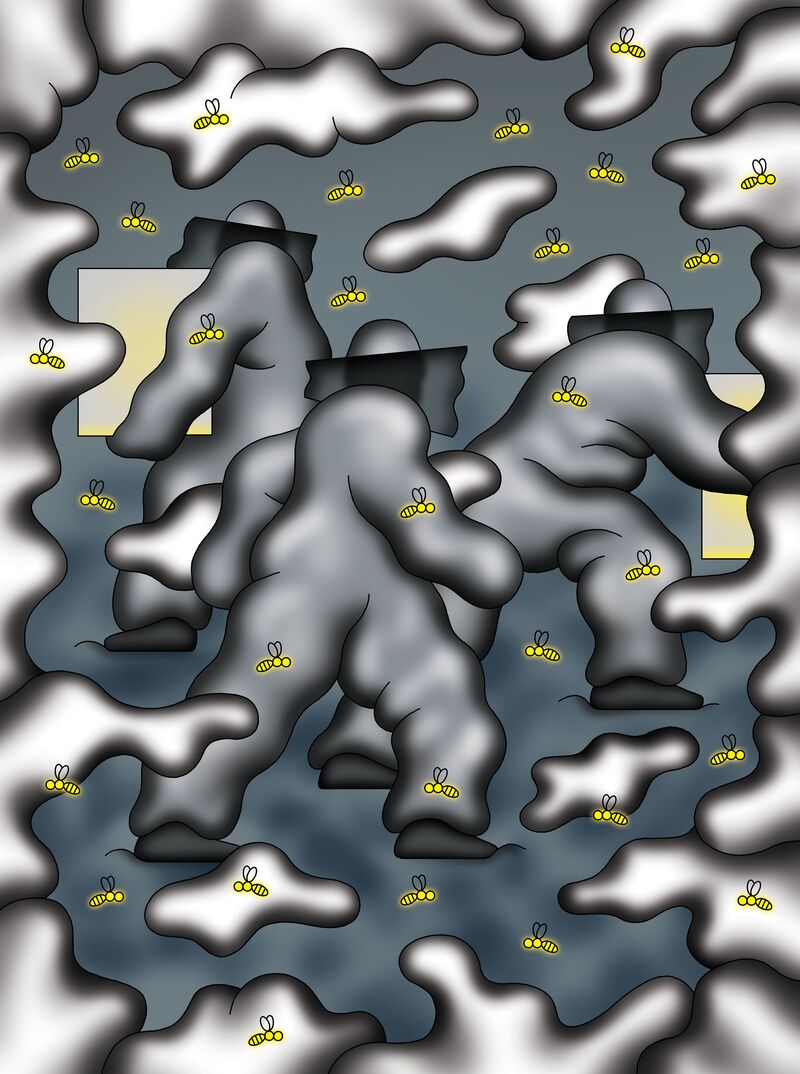
ILLUSTRATION: ALEXIS BEAUCLAIR FOR BLOOMBERG BUSINESSWEEK
Lloyd Cunniff felt terrible, literally sick to his stomach, about trucking his bees to California, but fate had painted him into a corner. Bad weather, bad luck, scrawny, needy bees—a whole mess of headaches had upset the economics at Beeline Honey, his third-generation apiary in Montana. It was colony collapse in 2015 that had really tipped things sideways. The mysterious affliction, which causes worker bees to vacate a hive en masse, had destroyed half of the Beeline colonies. Cunniff and his wife, Brenda, were down to 489 hives, when he bit the bullet and did the thing he really didn’t want to do.
In January 2017, Cunniff piled 488 of his 489 bee boxes—24 to a pallet—onto a semitruck trailer, strapped them down, and headed west to chase the sweet, sweet almond dollars that were drawing so many of his beekeeping brethren to California’s Central Valley. Loaning his bees out for a season, 1,000 miles away, made him very uncomfortable. But if your business is bees, California is where the big money is. Or it is at least in February, when 1.2 million acres of almond trees don’t get pollinated without the help of honeybees, which love almond flowers. California produces 80 percent of the world’s almonds, and over the past 15 years the trees have come to dominate the valley, pushing out all kinds of row crops. There aren’t enough California bees to pollinate them, so every year the call goes out to keepers: Bring your boxes west. An acre of almond trees needs at least two hives, meaning that every February, 2.5 million colonies—two-thirds of the commercial honeybee colonies in the U.S.—are clustered in a few California counties. Beekeepers command as much as $200 per hive for the season, which runs a few weeks.
You've reached your free article limit.
Subscribe now to get unlimited access.
View Offers Sign in
Bloomberg Anywhere clients get free access
How to Steal 50 Million Bees
rbkwp
Mythical Member
- Joined
- Aug 21, 2007
- Posts
- 93,221
- Media
- 1
- Likes
- 52,852
- Points
- 608
- Location
- Auckland, Auckland, NZ
- Sexuality
- 100% Gay, 0% Straight
- Gender
- Male
NZ as well,a big big problem
Australian Feral Cats Eat More Than a Million Reptiles Per Day
A new study shows cats snack on 258 reptile species, and could push some to the brink of extinction
image: https://thumbs-prod.si-cdn.com/K_IL...c-4766-b52e-50337113f520/istock-519429730.jpg
/https://public-media.smithsonianmag.com/filer/30/86/308652b7-f66c-4766-b52e-50337113f520/istock-519429730.jpg)
(istock/LaymanZoom)
By Jason Daley
SMITHSONIAN.COM
JUNE 26, 2018 1:30PM
blistering argument on the internet, just bring up feral cats, the descendants of our favorite domestic mouse catchers that are now living wild. While advocates argue they aren’t harming anyone and should be left alone, many conservationists see free-ranging cats as an environmental catastrophe. Recent studies suggest that in the United States alone, outdoor and feral cats kill 2.4 billion birds per year and as many as 12.3 billion small mammals. The U.S. is not the only place where the cuddly killers strike: Yasemin Saplakoglua at LiveScience reports a new study shows that feral cats in Australia are gobbling up over 1 million lizards a day, pushing some species to the brink of extinction.
To come up with that estimate, researchers looked at 80 previous studies that investigated cat predation on lizards, snakes and other reptiles, studying poo and stomach samples to determine how many and what types of creatures 10,000 Aussie cats ate. Cats, it turns out, aren’t picky when it comes to little reptiles. Researchers found 258 different species of reptiles in the samples, including 11 threatened species. The cats even snacked on some turtles.
According to AFP, the herps aren’t just an occasional kitty treat. “On average each feral cat kills 225 reptiles per year,” John Woinarski of Charles Darwin University, lead author of the study in the journal Wildlife Research, says. “Some cats eat staggering numbers of reptiles. We found many examples of single cats bingeing on lizards, with a record of 40 individual lizards in a single cat stomach.”
All told, extrapolating from the data, the researchers estimate the feral cat population in Australia, which totals between two and six million, now gobbles up 596 million lizards per year. Add in domestic pet cats that are allowed to roam outdoors and the total number jumps to 649 million reptiles lost to felines each year. That’s on top of 316 million birds cats kill annually in Australia.
Writing at The Conversation, the study authors say all that kitty carnage is likely taking a toll on Australia’s wildlife. “Such intensive predation probably puts severe pressure on local populations of some reptile species. There is now substantial evidence that cats are a primary cause of the ongoing decline of some threatened Australian reptile species, such as the great desert skink.”
Wildlife biologist Imogene Cancellare, not involved in the study, tells Maddie Stone at Earther that the new paper shows that cats fighting for survival in Australia’s hot, dry interior regions are gobbling up the most reptiles. “This means that in hot climates, feral cats are taking even more reptiles in order to survive,” she says. “As climate change continues to threaten biodiversity worldwide, the impact of feral cats will be felt even more severely than it is today.”
In fact, according to previous research, cat predation has been linked to the extinction of 20 mammal species in Australia already. That led the Australian government to initiate a cull in which it is trying to get rid of 2 million feral cats by 2020, reports Julie Power at The Sydney Morning Herald. “We are not culling cats for the sake of it, we are not doing so because we hate cats,” Australia’s Threatened Species Commissioner Gregory Andrews tells Power. “We have got to make choices to save animals that we love, and who define us as a nation like the bilby, the warru ([also called the] black-footed rock-wallaby) and the night parrot.”
People are getting creative to keep the cats out. Just last month, reports Brigit Katz at Smithsonian.com, the Australian Wildlife Conservancy switched on a 27-mile-long electric catproof fence, the largest in the world, to create a 23,000-acre cat-free preserve in Central Australia. The island nation of New Zealand, which is also seeing many of its iconic native species threatened by nonnative predators, has launched an even more ambitious project called Predator Free New Zealand. The goal is to rid the nation, which has no native land mammals besides bats, of feral cats, rats, possums, stoats and other predators by the year 2050.
In the United States, it’s unlikely we’ll see any wide-ranging control efforts like in Australia and New Zealand. Here, animal rights activists and ecologists have been squaring off for the last decade over a practice known at trap, neuter, and return, in which feral cats are captured, sterilized and vaccinated, then allowed to roam free. While that may, over time, help reduce the cat population, it still means billions of wild animals will become Fancy Feasts for years to come.
Read more: Australian Feral Cats Eat More Than a Million Reptiles Per Day | Smart News | Smithsonian
Give the gift of Smithsonian magazine for only $12! Give the gift of Smithsonian
Follow us: @SmithsonianMag on Twitter
Australian Feral Cats Eat More Than a Million Reptiles Per Day | Smart News | Smithsonian

rbkwp
Mythical Member
- Joined
- Aug 21, 2007
- Posts
- 93,221
- Media
- 1
- Likes
- 52,852
- Points
- 608
- Location
- Auckland, Auckland, NZ
- Sexuality
- 100% Gay, 0% Straight
- Gender
- Male
film buffs 2018 enjoy ha
The Best Films of 2018, So Far
Hear ye, hear ye: Richard Lawson and K. Austin Collins have surveyed the first six months of 2018 in film, and they’ve earmarked the 10 movies that stand above the crowd. It’s a wide-ranging list that covers everything from mainstream superhero blockbusters and moody documentaries to melancholy indies and that movieSteven Soderbergh shot on an iPhone—all great, and all very much worth your time and attention. Among these accomplished films, which is truly the cream of the crop? Lawson and Collins chose not to rank them just yet—but Collins, at least, is pulling for Paul Schrader’s First Reformed, a Taxi Driver for the modern age. “Schrader spins a shocking, politically agonized descent into moral chaos,” he writes. “It’s one of the most surprising films of the year—and, so far, the best.”
Elsewhere in HWD, Laura Bradley confirms that Oprah Winfrey did, in fact, find her way onto The Handmaid’s Tale; Jessica Chastain has a few tricks for subverting that insidious gender-wage gap; Lawson reviews Ant-Man and the Wasp, a delightful entry into the Marvel canon; and Yohana Desta handicaps Timothée Chalamet’schances at the 2019 Oscars, because around these parts, it’s truly never too early for awards season.
![]()
2018’s 10 Best Movies
So far, the list spans Annihilation to Zama—and it’s impressive enough that the next six months will have big shoes to fill.
READ MORE »
looks one i want to see mmmmm
![]()
You Get a Cameo!
Your ears did not deceive you: yes, that was Oprah Winfrey as the voice of resistance radio on the latest Handmaid’s Tale.
READ MORE »
![]()
How to End the Wage Gap
Helping Octavia Spencer get equal pay for an upcoming film was “the easiest thing in the world,” says Jessica Chastain—and she wants the rest of Hollywood to follow her lead.
READ MORE »
looks one i want to see m 2 mmmm
![]()
Just the Right Size
The Marvel Universe explores its lightest side in Ant-Man and the Wasp, a slight but hugely entertaining sequel.
READ MORE »
![]()
Make Way for Timothée
Here comes the first trailer for Beautiful Boy, a father-son story of addiction that just might get Chalamet another Oscar nomination.
READ MORE »
HWD Daily
The Best Films of 2018, So Far
Hear ye, hear ye: Richard Lawson and K. Austin Collins have surveyed the first six months of 2018 in film, and they’ve earmarked the 10 movies that stand above the crowd. It’s a wide-ranging list that covers everything from mainstream superhero blockbusters and moody documentaries to melancholy indies and that movieSteven Soderbergh shot on an iPhone—all great, and all very much worth your time and attention. Among these accomplished films, which is truly the cream of the crop? Lawson and Collins chose not to rank them just yet—but Collins, at least, is pulling for Paul Schrader’s First Reformed, a Taxi Driver for the modern age. “Schrader spins a shocking, politically agonized descent into moral chaos,” he writes. “It’s one of the most surprising films of the year—and, so far, the best.”
Elsewhere in HWD, Laura Bradley confirms that Oprah Winfrey did, in fact, find her way onto The Handmaid’s Tale; Jessica Chastain has a few tricks for subverting that insidious gender-wage gap; Lawson reviews Ant-Man and the Wasp, a delightful entry into the Marvel canon; and Yohana Desta handicaps Timothée Chalamet’schances at the 2019 Oscars, because around these parts, it’s truly never too early for awards season.

2018’s 10 Best Movies
So far, the list spans Annihilation to Zama—and it’s impressive enough that the next six months will have big shoes to fill.
READ MORE »
looks one i want to see mmmmm

You Get a Cameo!
Your ears did not deceive you: yes, that was Oprah Winfrey as the voice of resistance radio on the latest Handmaid’s Tale.
READ MORE »

How to End the Wage Gap
Helping Octavia Spencer get equal pay for an upcoming film was “the easiest thing in the world,” says Jessica Chastain—and she wants the rest of Hollywood to follow her lead.
READ MORE »
looks one i want to see m 2 mmmm

Just the Right Size
The Marvel Universe explores its lightest side in Ant-Man and the Wasp, a slight but hugely entertaining sequel.
READ MORE »

Make Way for Timothée
Here comes the first trailer for Beautiful Boy, a father-son story of addiction that just might get Chalamet another Oscar nomination.
READ MORE »
HWD Daily
rbkwp
Mythical Member
- Joined
- Aug 21, 2007
- Posts
- 93,221
- Media
- 1
- Likes
- 52,852
- Points
- 608
- Location
- Auckland, Auckland, NZ
- Sexuality
- 100% Gay, 0% Straight
- Gender
- Male
may encourage others
not suggesting its not happening elsewhere
Food
Inside the New Zealand kitchen empowering women refugees
GlobalPost
June 27, 2018 · 9:30 AM EDT
By Rina Diane Caballar
Pomegranate Kitchen 1.jpg
![Pomegranate%20Kitchen%201.jpg]()
Rebecca Stewart is the general manager and co-founder of Pomegranate Kitchen. She's pictured (far right) with other cooks working in the kitchen.
Credit:
Courtesy of Rebecca Stewart/Pomegranate Kitchen
Government discussion surrounding refugees oftentimes revolves around costs and quotas; the human element can get lost in the conversation. In order to add a personal touch to refugees' experiences in a new land — as well as to help them gain workplace skills — a social enterprise in New Zealand is making sure they’re known not by the label "refugee," but instead for the talents and know-how they bring to their new home.
Pomegranate Kitchen is an organization in Wellington, New Zealand’s capital city, that employs women refugees. They provide catering services — from light snacks and office lunches to sit-down dinners and large celebrations. The organization was selected last year as a top five New Zealand venture by SheEO, a global initiative created to radically transform how to finance, support and celebrate female entrepreneurs.
Related: In a Puerto Rico neighborhood still waiting for power, this community kitchen is like ‘therapy’
“We were trying to find something that encapsulated the food [we were cooking] and the work we were doing. So, in the end, we settled on a simple, fresh and healthy fruit — pomegranate,” said 33-year-old Rebecca Stewart, the co-founder and general manager of Pomegranate Kitchen, about the genesis of the organization's name. She and her stepmom, Ange Wither, started Pomegranate Kitchen in October 2016 to provide employment opportunities for refugees.
“When I worked for the New Zealand Red Cross, I saw a lot of people who wanted to work but couldn’t get their foot in the door because of language barriers or lack of local experience,” said Stewart. Pomegranate Kitchen provides a way for women refugees to get past these challenges and earn an income using the skills they already have.
New Zealand has had its share of issues when it comes to taking in refugees. The country established a yearly quota of 750 refugees in 1987, but calls to double that quota emerged in recent years. In 2015, the government announced that the country would be taking in another 600 Syrian refugees on top of the annual quota. Starting this year, the refugee quota is set to double annually — from the previous 750 to 1,500 — under the new Labour-led government.
“We should be thinking about what people from a refugee background can bring rather than what they cost us,” Stewart said. “That’s a really important thing about what we do — trying to see the talent in people, see what individual skills they bring and what other skills can be developed. Not putting people in a box of just being cooks or refugees.”
Related: In northern Uganda, these women move past insurgency by baking cakes
The catering social enterprise currently has seven cooks from Afghanistan, Ethiopia, Iraq, Palestine and Syria. They’re trained to work in a commercial kitchen, an experience that equips them with skills in recipe creation, health and safety, and stock management. “They’re all really great cooks, so we didn’t need to do a lot of cooking training. The training we provide is more around food safety in a commercial setting and working to precise numbers on a large scale. We have a focus on capacity building, but we’re trying to maintain consistency,” said Stewart.
Pomegranate Kitchen celebrates the cuisines of these women, allowing them to cook dishes from across their homelands: baklava, falafel wraps, fattoush salad, kuku sabzi, tahini cookies and more. The recipes are all their own. “They’re making things they know how to make. And the way we work is quite different from a commercial kitchen. It’s less hierarchical and more collaborative,” Stewart said.
mixed dish_0.jpg
![mixed%20dish_0.jpg]()
The cooks at Pomegranate Kitchen make dishes from their respective homelands.
Credit:
Rebecca Stewart/Pomegranate Kitchen
One of the Pomegranate Kitchen cooks, a former refugee from Iraq who asked not to be named, has been with the social enterprise for a year. She says that working here has been rewarding in more than one way. “I’m happy because people are interested to learn about my culture and enjoy the food we offer,” she said.
More importantly, these women are involved at all levels of Pomegranate Kitchen. Their previous head chef was instrumental in helping build the social enterprise, designing systems in the kitchen and menu items. Another head chef helped with administration tasks. They also have a board member from a refugee background. This allows the social enterprise to stay true to one of their values: “No decisions about us without us.”
A social enterprise like Pomegranate Kitchen is not without its challenges, however. During their early days, they had to work out of a kitchen they shared with another restaurant. They eventually moved to their own space last year. It has also been tough trying to operate in a saturated market of caterers in Wellington. “We’ve been really lucky that so many people in the community understand what we’re trying to do and support it. They buy our food, talk about it and share our stories,” said Stewart.
Yet another difficulty is navigating cultural differences. “Our cooks are the head cooks in their own home kitchens, so they have their own way of making things. There are some strong personalities there but everyone’s professional and getting along really well,” Stewart says. “It’s a wonderful experience working with people from different backgrounds and getting to know them. Our cooks all work so hard, and I find them a real joy to work with.”
But for Stewart, the biggest success of the business is seeing the changes in the women they’re working with. “We do an evaluation every year, and our cooks have reported that their skills have developed — math skills, interpersonal and managerial skills, time management and English-language skills,” she adds.
For now, the social enterprise’s main focus is to strengthen the business and employ more people for more hours. But in the future, Stewart says they’d love to do cooking classes, create shelf products and open in other areas.
For the women of Pomegranate Kitchen, food is more than a source of income. It’s a way to stay linked to their culture and enable others to experience new tastes. “Food is one of the ways people show love for each other, and sharing a meal together allows people to speak without having a common language,” said Stewart. “We like to think of it as community building. Our cooks are sharing their food and bridging the cultural divide.”
Inside the New Zealand kitchen empowering women refugees
not suggesting its not happening elsewhere
Food
Inside the New Zealand kitchen empowering women refugees
GlobalPost
June 27, 2018 · 9:30 AM EDT
By Rina Diane Caballar
Pomegranate Kitchen 1.jpg
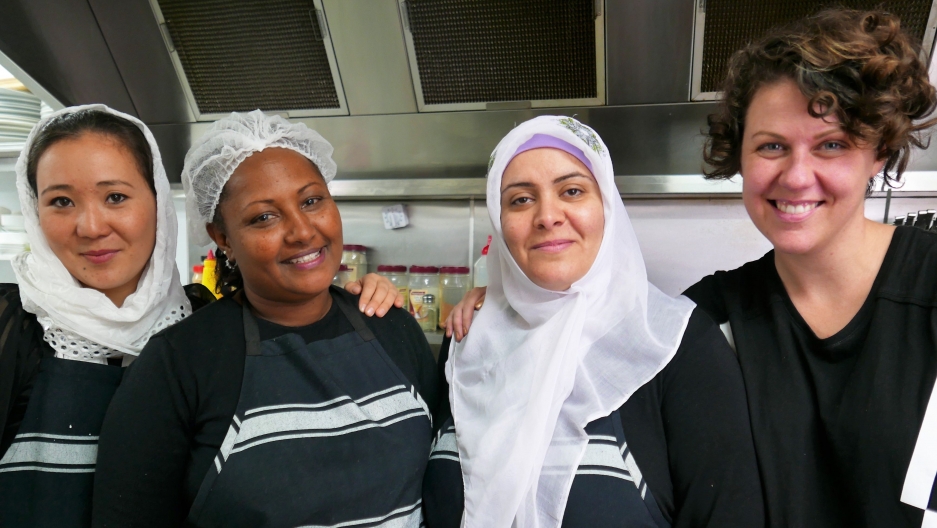
Rebecca Stewart is the general manager and co-founder of Pomegranate Kitchen. She's pictured (far right) with other cooks working in the kitchen.
Credit:
Courtesy of Rebecca Stewart/Pomegranate Kitchen
Government discussion surrounding refugees oftentimes revolves around costs and quotas; the human element can get lost in the conversation. In order to add a personal touch to refugees' experiences in a new land — as well as to help them gain workplace skills — a social enterprise in New Zealand is making sure they’re known not by the label "refugee," but instead for the talents and know-how they bring to their new home.
Pomegranate Kitchen is an organization in Wellington, New Zealand’s capital city, that employs women refugees. They provide catering services — from light snacks and office lunches to sit-down dinners and large celebrations. The organization was selected last year as a top five New Zealand venture by SheEO, a global initiative created to radically transform how to finance, support and celebrate female entrepreneurs.
Related: In a Puerto Rico neighborhood still waiting for power, this community kitchen is like ‘therapy’
“We were trying to find something that encapsulated the food [we were cooking] and the work we were doing. So, in the end, we settled on a simple, fresh and healthy fruit — pomegranate,” said 33-year-old Rebecca Stewart, the co-founder and general manager of Pomegranate Kitchen, about the genesis of the organization's name. She and her stepmom, Ange Wither, started Pomegranate Kitchen in October 2016 to provide employment opportunities for refugees.
“When I worked for the New Zealand Red Cross, I saw a lot of people who wanted to work but couldn’t get their foot in the door because of language barriers or lack of local experience,” said Stewart. Pomegranate Kitchen provides a way for women refugees to get past these challenges and earn an income using the skills they already have.
New Zealand has had its share of issues when it comes to taking in refugees. The country established a yearly quota of 750 refugees in 1987, but calls to double that quota emerged in recent years. In 2015, the government announced that the country would be taking in another 600 Syrian refugees on top of the annual quota. Starting this year, the refugee quota is set to double annually — from the previous 750 to 1,500 — under the new Labour-led government.
“We should be thinking about what people from a refugee background can bring rather than what they cost us,” Stewart said. “That’s a really important thing about what we do — trying to see the talent in people, see what individual skills they bring and what other skills can be developed. Not putting people in a box of just being cooks or refugees.”
Related: In northern Uganda, these women move past insurgency by baking cakes
The catering social enterprise currently has seven cooks from Afghanistan, Ethiopia, Iraq, Palestine and Syria. They’re trained to work in a commercial kitchen, an experience that equips them with skills in recipe creation, health and safety, and stock management. “They’re all really great cooks, so we didn’t need to do a lot of cooking training. The training we provide is more around food safety in a commercial setting and working to precise numbers on a large scale. We have a focus on capacity building, but we’re trying to maintain consistency,” said Stewart.
Pomegranate Kitchen celebrates the cuisines of these women, allowing them to cook dishes from across their homelands: baklava, falafel wraps, fattoush salad, kuku sabzi, tahini cookies and more. The recipes are all their own. “They’re making things they know how to make. And the way we work is quite different from a commercial kitchen. It’s less hierarchical and more collaborative,” Stewart said.
mixed dish_0.jpg

The cooks at Pomegranate Kitchen make dishes from their respective homelands.
Credit:
Rebecca Stewart/Pomegranate Kitchen
One of the Pomegranate Kitchen cooks, a former refugee from Iraq who asked not to be named, has been with the social enterprise for a year. She says that working here has been rewarding in more than one way. “I’m happy because people are interested to learn about my culture and enjoy the food we offer,” she said.
More importantly, these women are involved at all levels of Pomegranate Kitchen. Their previous head chef was instrumental in helping build the social enterprise, designing systems in the kitchen and menu items. Another head chef helped with administration tasks. They also have a board member from a refugee background. This allows the social enterprise to stay true to one of their values: “No decisions about us without us.”
A social enterprise like Pomegranate Kitchen is not without its challenges, however. During their early days, they had to work out of a kitchen they shared with another restaurant. They eventually moved to their own space last year. It has also been tough trying to operate in a saturated market of caterers in Wellington. “We’ve been really lucky that so many people in the community understand what we’re trying to do and support it. They buy our food, talk about it and share our stories,” said Stewart.
Yet another difficulty is navigating cultural differences. “Our cooks are the head cooks in their own home kitchens, so they have their own way of making things. There are some strong personalities there but everyone’s professional and getting along really well,” Stewart says. “It’s a wonderful experience working with people from different backgrounds and getting to know them. Our cooks all work so hard, and I find them a real joy to work with.”
But for Stewart, the biggest success of the business is seeing the changes in the women they’re working with. “We do an evaluation every year, and our cooks have reported that their skills have developed — math skills, interpersonal and managerial skills, time management and English-language skills,” she adds.
For now, the social enterprise’s main focus is to strengthen the business and employ more people for more hours. But in the future, Stewart says they’d love to do cooking classes, create shelf products and open in other areas.
For the women of Pomegranate Kitchen, food is more than a source of income. It’s a way to stay linked to their culture and enable others to experience new tastes. “Food is one of the ways people show love for each other, and sharing a meal together allows people to speak without having a common language,” said Stewart. “We like to think of it as community building. Our cooks are sharing their food and bridging the cultural divide.”
Inside the New Zealand kitchen empowering women refugees
rbkwp
Mythical Member
- Joined
- Aug 21, 2007
- Posts
- 93,221
- Media
- 1
- Likes
- 52,852
- Points
- 608
- Location
- Auckland, Auckland, NZ
- Sexuality
- 100% Gay, 0% Straight
- Gender
- Male
WHAT DO NEW BLOOD PRESSURE GUIDELINES MEAN FOR YOU?
BY JOHN WARNER ON 6/26/18 AT 8:25 AM
SHARE
TECH & SCIENCEPUBLIC HEALTHHIGH BLOOD PRESSUREDISEASES
Updated blood pressure guidelines from the American Heart Association (AHA) mean that many more Americans,notably older people, are now diagnosed with high blood pressure, or hypertension. This may sound like bad news, but the new guidelines highlight some important lessons we cardiologists and heart health researchers have learned from the latest blood pressure studies. Specifically, we have learned that damage from high blood pressure starts at much lower blood pressures than previously thought and that it is more important than ever to start paying attention to your blood pressure before it starts causing problems.
High blood pressure accounts for more heart disease and stroke deaths than all other preventable causes, except smoking.
As president of the AHA and a cardiologist, I completely support the latest guidelines. I know they will save lives, especially when blood pressure is accurately checked and when people make therapeutic lifestyle choices to lower their blood pressure.
How high blood pressure damages
High blood pressure, which occurs when the force of blood pushing against blood vessel walls is too high, is similar to turning up the water in a garden hose—pressure in the hose increases as more water is blasted through it. The added pressure causes the heart to work too hard and blood vessels to function less effectively. Over time, the stress damages the tissues within blood vessels, which can further damage the heart and circulatory system.
Recommended Slideshows
![]() 30
30
In Pictures: Fujitsu Forum, One of Tokyo's Biggest Tech Shows
The Best Pictures Ever Taken in Space
The AHA, the American College of Cardiology and nine other health professional organizations reviewed more than 900 studies as part of a rigorous review and approval process to develop this first update since 2003 to comprehensive U.S. high blood pressure guidelines.
Here’s what’s new:
![bp.jpg]() New blood pressure guidelines from the American Heart Association.AMERICAN HEART ASSOCIATION
New blood pressure guidelines from the American Heart Association.AMERICAN HEART ASSOCIATION
Putting the guidelines to work
Hypertension is known as the “silent killer” because often there are no obvious symptoms. The only way to know whether you have it is by having your blood pressure measured. Accurate blood pressure measurement is critical to a correct diagnosis.
The guidelines emphasize use of proper technique to measure blood pressure, whether taken by a health care professional in the clinic or by the patient using a home blood pressure monitoring device. Blood pressure levels should be based on an average of two to three readings on at least two different occasions.
A number of common errors can inflate a reading. These include having a full bladder, slouching with unsupported back or feet, sitting with crossed legs, or talking while being measured; using a cuff that is too small or wrapping the cuff over clothing; and not supporting the arm being measured on a chair or counter to keep it level with the heart.
An accurate reading is critical to a correct diagnosis, faster treatment and the most appropriate care.
The lower threshold for a diagnosis of high blood pressure increases the percentage of U.S. adults (ages 20 and older) who have the condition, from approximately 1 in 3 to nearly half (46 percent).
Even with the new threshold, the percentage of U.S. adults for whom medication is recommended (along with lifestyle management) will increase only slightly. Most of the people who are newly diagnosed with high blood pressure will be advised to make lifestyle changes to shift their blood pressure into a healthy zone.
The promise of healthy lifestyle changes
Damage to blood vessels begins soon after blood pressure is elevated. Early intervention can help prevent problems, slow damage that has already started and lower the risk for a heart disease or stroke. Lifestyle changes should be on the front lines of efforts to tackle the high blood pressure epidemic.
![niiranenimg1261002.jpg]() A medical study participant undergoing blood pressure measurements.AMERICAN HEART ASSOCIATION
A medical study participant undergoing blood pressure measurements.AMERICAN HEART ASSOCIATION
Here are some of the best proven nondrug approaches to prevent and treat high blood pressure
John Warner, Executive Vice President, Health Affairs, UT Southwestern Medical Center.
What do the new blood pressure guidelines mean for you?
BY JOHN WARNER ON 6/26/18 AT 8:25 AM
SHARE
TECH & SCIENCEPUBLIC HEALTHHIGH BLOOD PRESSUREDISEASES
Updated blood pressure guidelines from the American Heart Association (AHA) mean that many more Americans,notably older people, are now diagnosed with high blood pressure, or hypertension. This may sound like bad news, but the new guidelines highlight some important lessons we cardiologists and heart health researchers have learned from the latest blood pressure studies. Specifically, we have learned that damage from high blood pressure starts at much lower blood pressures than previously thought and that it is more important than ever to start paying attention to your blood pressure before it starts causing problems.
High blood pressure accounts for more heart disease and stroke deaths than all other preventable causes, except smoking.
As president of the AHA and a cardiologist, I completely support the latest guidelines. I know they will save lives, especially when blood pressure is accurately checked and when people make therapeutic lifestyle choices to lower their blood pressure.
How high blood pressure damages
High blood pressure, which occurs when the force of blood pushing against blood vessel walls is too high, is similar to turning up the water in a garden hose—pressure in the hose increases as more water is blasted through it. The added pressure causes the heart to work too hard and blood vessels to function less effectively. Over time, the stress damages the tissues within blood vessels, which can further damage the heart and circulatory system.
Recommended Slideshows

In Pictures: Fujitsu Forum, One of Tokyo's Biggest Tech Shows
The Best Pictures Ever Taken in Space
The AHA, the American College of Cardiology and nine other health professional organizations reviewed more than 900 studies as part of a rigorous review and approval process to develop this first update since 2003 to comprehensive U.S. high blood pressure guidelines.
Here’s what’s new:
- High blood pressure, previously defined as 140/90 mm Hg or higher, is now defined as 130/80 mm Hg or higher. This change reflects the latest research that shows health problems can occur at those lower levels. Risk for heart attack, stroke and other consequences begins anywhere above 120 mm Hg (for systolic blood pressure, the top number in a reading), and risk doubles at 130 mm Hg compared to levels below 120.
See All Of The Best Photos Of The Week In These Slideshows
- Blood pressure in adults will be categorized as normal, elevated, stage 1 hypertension or stage 2 hypertension. The category “prehypertension” is no longer used; it previously referred to blood pressures with a top number (systolic) between 120-139 mm Hg or a bottom number (diastolic) between 80-89 mm Hg. People with those readings are now categorized as having either Elevated or Stage I hypertension.
- Determination of eligibility for blood pressure-lowering medication treatment is no longer based solely on blood pressure level. It now also considers a patient’s risk of heart disease or stroke over the next 10 years, based on a risk calculator. For people with blood pressure higher than 140/90 mm Hg, medication is recommended regardless of risk level.

Putting the guidelines to work
Hypertension is known as the “silent killer” because often there are no obvious symptoms. The only way to know whether you have it is by having your blood pressure measured. Accurate blood pressure measurement is critical to a correct diagnosis.
The guidelines emphasize use of proper technique to measure blood pressure, whether taken by a health care professional in the clinic or by the patient using a home blood pressure monitoring device. Blood pressure levels should be based on an average of two to three readings on at least two different occasions.
A number of common errors can inflate a reading. These include having a full bladder, slouching with unsupported back or feet, sitting with crossed legs, or talking while being measured; using a cuff that is too small or wrapping the cuff over clothing; and not supporting the arm being measured on a chair or counter to keep it level with the heart.
An accurate reading is critical to a correct diagnosis, faster treatment and the most appropriate care.
The lower threshold for a diagnosis of high blood pressure increases the percentage of U.S. adults (ages 20 and older) who have the condition, from approximately 1 in 3 to nearly half (46 percent).
Even with the new threshold, the percentage of U.S. adults for whom medication is recommended (along with lifestyle management) will increase only slightly. Most of the people who are newly diagnosed with high blood pressure will be advised to make lifestyle changes to shift their blood pressure into a healthy zone.
The promise of healthy lifestyle changes
Damage to blood vessels begins soon after blood pressure is elevated. Early intervention can help prevent problems, slow damage that has already started and lower the risk for a heart disease or stroke. Lifestyle changes should be on the front lines of efforts to tackle the high blood pressure epidemic.

Here are some of the best proven nondrug approaches to prevent and treat high blood pressure
John Warner, Executive Vice President, Health Affairs, UT Southwestern Medical Center.
What do the new blood pressure guidelines mean for you?


rbkwp
Mythical Member
- Joined
- Aug 21, 2007
- Posts
- 93,221
- Media
- 1
- Likes
- 52,852
- Points
- 608
- Location
- Auckland, Auckland, NZ
- Sexuality
- 100% Gay, 0% Straight
- Gender
- Male
site intiuges me
each day i wonder why it exists and ook for an interesting article to read
this comment of western parents may learn something intriuges ha
well some
but i think its just too much of a good thing
how to raise a human
smile,listen
A Lost Secret: How To Get Kids To Pay Attention
![96QnkzvhcS0egJ4W6rUNfRS8waJRI7-Bu21Iw7Aer3wNXC7cqkuRDs1mpifRG3z6MbT5geYFPHdQsypm7nLN-wv8WzRSfc2NKmV-FycojyFq0unai5j6p0tPnITNpq7IqPVnO3mXnJyaiTyEbwLhwzc=s0-d-e1-ft]()
editor's note
It's a question that every parent asks: How do your get kids to pay attention to ... well, to everything, from schoolwork to the laundry that needs folding to Kitty's empty water dish?
In our latest post in the How To Raise A Human series, correspondent Michaeleen Doucleff visited a Maya village where the children perform very well on tests to measure attention.
Read this story here.
#HowToRaiseAHuman
One theory is that the parents have somehow motivated their children to be attentive without even having to tell them.
What's their secret? And can Western parents take a lesson?
Marc Silver
Editor, Goats and Soda
A Lost Secret: How To Get Kids To Pay Attention
each day i wonder why it exists and ook for an interesting article to read
this comment of western parents may learn something intriuges ha
well some
but i think its just too much of a good thing
how to raise a human
smile,listen
A Lost Secret: How To Get Kids To Pay Attention

editor's note
It's a question that every parent asks: How do your get kids to pay attention to ... well, to everything, from schoolwork to the laundry that needs folding to Kitty's empty water dish?
In our latest post in the How To Raise A Human series, correspondent Michaeleen Doucleff visited a Maya village where the children perform very well on tests to measure attention.
Read this story here.
#HowToRaiseAHuman
One theory is that the parents have somehow motivated their children to be attentive without even having to tell them.
What's their secret? And can Western parents take a lesson?
Marc Silver
Editor, Goats and Soda
A Lost Secret: How To Get Kids To Pay Attention
rbkwp
Mythical Member
- Joined
- Aug 21, 2007
- Posts
- 93,221
- Media
- 1
- Likes
- 52,852
- Points
- 608
- Location
- Auckland, Auckland, NZ
- Sexuality
- 100% Gay, 0% Straight
- Gender
- Male
ALWAYS BEEN AN OBVIOUS i would have thought
why they feel a need to place this out there now as aa new found thing,be damned
Study Suggests be damned
can never undestand the often human idiocy of sensible personal health care,apart from countries that have a chronic shortage of Drs
why they have facilities that only ever offer a
'take whatever Drs available service'
![]()
Seeing the Same Doctor 'Is a Matter of Life and Death,' Study Suggests
Advantages of seeing the same doctor include a lower risk of being hospitalized, according to...
why they feel a need to place this out there now as aa new found thing,be damned
Study Suggests be damned
can never undestand the often human idiocy of sensible personal health care,apart from countries that have a chronic shortage of Drs
why they have facilities that only ever offer a
'take whatever Drs available service'

Seeing the Same Doctor 'Is a Matter of Life and Death,' Study Suggests
Advantages of seeing the same doctor include a lower risk of being hospitalized, according to...
rbkwp
Mythical Member
- Joined
- Aug 21, 2007
- Posts
- 93,221
- Media
- 1
- Likes
- 52,852
- Points
- 608
- Location
- Auckland, Auckland, NZ
- Sexuality
- 100% Gay, 0% Straight
- Gender
- Male
INDIGENOUS AUSTRALIAN style
and probably all other cultures/countries WW going by whats been read
wonder if it was for dominance,slavery or sexal gratification
i dont mind saying/suggeting posibilities
dont need to be an educated academic with degrees to have the right to suggest anything
SMARTNEWS Keeping you current
Daisy Kadibil’s Story of Escape Called Attention to the “Stolen Generations” of Aboriginal Australians
Kadibil, who died at the age of 95, had her incredible odyssey recounted in the acclaimed 2002 film ‘Rabbit-Proof Fence’
Still from the movie Rabbit-Proof Fence, which chronicles the real-life odyssey of Daisy Kadibil, her sister Molly and her cousin Gracie.(Entertainment Pictures / Alamy Stock Photo)
By Brigit Katz
SMITHSONIAN.COM
JUNE 29, 2018 2:14PM
acclaimed 2002 film.
As Jacqueline Williams reports for the New York Times, Daisy, the youngest and last surviving member of the trio, died on March 30 at the age of 95. Her death was not widely reported until recently.
Before they were taken from their homes, Daisy, Molly and Gracie lived in Jigalong, a remote indigenous community that lived semi-nomadically along the rabbit-proof fence—a more than 2,000-mile stretch of barbed wire fencing that was erected in 1900 to keep rabbits out of farmland in Western Australia.
The girls, who belonged to the Martu people, were born at a time when the Australian government was forcibly placing many indigenous children in resettlement institutions, with the goal of assimilating them into white culture. A government inquiry launched in 1995 found that from 1910 to 1970, between 10 and 33 percent of all Australian indigenous children were separated from their families. These children are known collectively as theStolen Generations.
Christine Olsen, the producer of Rabbit-Proof Fence, interviewed both Molly and Daisy while researching the script for the film. She recollects in the Sydney Morning Herald that because their fathers were white, the three girls came to the attention of Australian authorities, particularly Auber Octavius Neville, the “Chief Protector of Aborigines” who played an important role in shaping official policy toward Australia’s indigenous people in the early 20th century. According to Olsen, Neville believed that mixed-race Aboriginal children should be removed from their families and integrated into European society, “where they would marry and have whiter and whiter children.”
Daisy, Molly and Gracie were taken to the Moore River Native Settlement, a grim assimilation camp where 374 people died—many of them from treatable respiratory and infectious illnesses, according to recent research. Molly, who was the oldest of the three girls, had no intention of staying at Moore River. “That place make me sick,” Olsen remembers her saying.
One night, Molly led Daisy and Gracie out of the camp. As they walked alone for more than two months, they hunted and lived off the land. Famers’ wives sometimes gave them food. At other times, they had to steal to eat. Once the girls found the rabbit-proof fence, they were able to follow it back to Jigalong. But the police had been dispatched to catch the girls. According to Olsen, Gracie was recaptured. Molly and Daisy made it home.
In 1996, Molly’s daughter, Doris Pilkington Garimara, published the book Follow the Rabbit-Proof Fence, which was based on the girls’ escape from the Moore River settlement. The 2002 film was inspired by the book, and according to the National Film and Sound Archive of Australia, it “introduced many people to the concept of the stolen generations.”
As an adult, Daisy worked as a cook and housekeeper on ranches in the Pilbara region. According to Olsen, Daisy taught her four children how to hunt and “look after the land,” ensuring that they would be able to pass on the traditions of their ancestors.
In the 1980s, one of Daisy’s daughters, Noreena Kadibil, helped found the Parnngurr Aboriginal Community. Daisy spent her later years living there—not far from Jigalong, her beloved childhood home along the rabbit-proof fence.
Daisy Kadibil’s Story of Escape Called Attention to the "Stolen Generations" of Aboriginal Australians | Smart News | Smithsonian
and probably all other cultures/countries WW going by whats been read
wonder if it was for dominance,slavery or sexal gratification
i dont mind saying/suggeting posibilities
dont need to be an educated academic with degrees to have the right to suggest anything
SMARTNEWS Keeping you current
Daisy Kadibil’s Story of Escape Called Attention to the “Stolen Generations” of Aboriginal Australians
Kadibil, who died at the age of 95, had her incredible odyssey recounted in the acclaimed 2002 film ‘Rabbit-Proof Fence’
Still from the movie Rabbit-Proof Fence, which chronicles the real-life odyssey of Daisy Kadibil, her sister Molly and her cousin Gracie.(Entertainment Pictures / Alamy Stock Photo)
By Brigit Katz
SMITHSONIAN.COM
JUNE 29, 2018 2:14PM
acclaimed 2002 film.
As Jacqueline Williams reports for the New York Times, Daisy, the youngest and last surviving member of the trio, died on March 30 at the age of 95. Her death was not widely reported until recently.
Before they were taken from their homes, Daisy, Molly and Gracie lived in Jigalong, a remote indigenous community that lived semi-nomadically along the rabbit-proof fence—a more than 2,000-mile stretch of barbed wire fencing that was erected in 1900 to keep rabbits out of farmland in Western Australia.
The girls, who belonged to the Martu people, were born at a time when the Australian government was forcibly placing many indigenous children in resettlement institutions, with the goal of assimilating them into white culture. A government inquiry launched in 1995 found that from 1910 to 1970, between 10 and 33 percent of all Australian indigenous children were separated from their families. These children are known collectively as theStolen Generations.
Christine Olsen, the producer of Rabbit-Proof Fence, interviewed both Molly and Daisy while researching the script for the film. She recollects in the Sydney Morning Herald that because their fathers were white, the three girls came to the attention of Australian authorities, particularly Auber Octavius Neville, the “Chief Protector of Aborigines” who played an important role in shaping official policy toward Australia’s indigenous people in the early 20th century. According to Olsen, Neville believed that mixed-race Aboriginal children should be removed from their families and integrated into European society, “where they would marry and have whiter and whiter children.”
Daisy, Molly and Gracie were taken to the Moore River Native Settlement, a grim assimilation camp where 374 people died—many of them from treatable respiratory and infectious illnesses, according to recent research. Molly, who was the oldest of the three girls, had no intention of staying at Moore River. “That place make me sick,” Olsen remembers her saying.
One night, Molly led Daisy and Gracie out of the camp. As they walked alone for more than two months, they hunted and lived off the land. Famers’ wives sometimes gave them food. At other times, they had to steal to eat. Once the girls found the rabbit-proof fence, they were able to follow it back to Jigalong. But the police had been dispatched to catch the girls. According to Olsen, Gracie was recaptured. Molly and Daisy made it home.
In 1996, Molly’s daughter, Doris Pilkington Garimara, published the book Follow the Rabbit-Proof Fence, which was based on the girls’ escape from the Moore River settlement. The 2002 film was inspired by the book, and according to the National Film and Sound Archive of Australia, it “introduced many people to the concept of the stolen generations.”
As an adult, Daisy worked as a cook and housekeeper on ranches in the Pilbara region. According to Olsen, Daisy taught her four children how to hunt and “look after the land,” ensuring that they would be able to pass on the traditions of their ancestors.
In the 1980s, one of Daisy’s daughters, Noreena Kadibil, helped found the Parnngurr Aboriginal Community. Daisy spent her later years living there—not far from Jigalong, her beloved childhood home along the rabbit-proof fence.
Daisy Kadibil’s Story of Escape Called Attention to the "Stolen Generations" of Aboriginal Australians | Smart News | Smithsonian
rbkwp
Mythical Member
- Joined
- Aug 21, 2007
- Posts
- 93,221
- Media
- 1
- Likes
- 52,852
- Points
- 608
- Location
- Auckland, Auckland, NZ
- Sexuality
- 100% Gay, 0% Straight
- Gender
- Male
Happy Friday, Please Enjoy This Incredible Video of Two Canadians Trying to Avoid Arrest at a Convenience Store
![mc_cWQwZHqqSn9e8-XCoYS1NzUXdFP9MXHDMOapbCSb_PWvQnDneEFZcdK_XVzM897kGwnL8_Vjyeej97kHs0nciGdsfisC-NdUUFmnxM-tXbxcop83Ogr79PTAqu5DvkqzSIc17AV74FDIbwGlZn9gpZfkoNLWqRVGh_joO4RoYdGhsxddtzAQyfm-9KwGY0Q=s0-d-e1-ft]()
Happy Friday, Please Enjoy This Incredible Video of Two Canadians Trying to Avoid Arrest at a Convenience Store
Please Enjoy This Incredible Video of Two Canadians Trying to Avoid Arrest at a Convenience Store

Happy Friday, Please Enjoy This Incredible Video of Two Canadians Trying to Avoid Arrest at a Convenience Store
Please Enjoy This Incredible Video of Two Canadians Trying to Avoid Arrest at a Convenience Store

I need to pierce or tattoo something, like, really soon. I need more needles in my life.


I need to pierce or tattoo something, like, really soon. I need more needles in my life.
I've been wanting one for years, just haven't found the right artist to trust yet. I can make some really gnarly sketches though, and have often been told I should do tattoos. But I don't think that was my calling, My goal is to make it to forensic art.
rbkwp
Mythical Member
- Joined
- Aug 21, 2007
- Posts
- 93,221
- Media
- 1
- Likes
- 52,852
- Points
- 608
- Location
- Auckland, Auckland, NZ
- Sexuality
- 100% Gay, 0% Straight
- Gender
- Male
an
animal am/domestic not feal ohjhhhhhhhhhhhhh
The scientific reason you still believe in superstitions
Neil Dagnall & Ken Drinkwater
2 hours ago

Nothing to fear. (Pixabay)
The number 13, black cats, breaking mirrors, or walking under ladders, may all be things you actively avoid—if you’re anything like the 25% of people in the US who consider themselves superstitious.
The scientific reason you still believe in superstitions

Todd the Golden Retriever Saves Owner from Rattlesnake, Suffers Bite Himself in the Process
Arizona woman shares photos of puppy's injuries after he protected her from a snake attack.
Similar threads
- Replies
- 17
- Views
- 501


- Replies
- 4
- Views
- 2K

- Replies
- 4
- Views
- 558

- Replies
- 15
- Views
- 3K