Apparently,

How Did All the Horses Get to Rio for the 2016 Olympics?

apparently
would have been better to be a horse at Rio,.mebeee


Foreign horses competing in Olympic equestrian events must have their own
passports.

Like any athlete traveling to Rio de Janeiro for the 2016 Olympic Games,
about 200 horses that competed in equestrian events had to go through
customs, have a passport, submit to equipment inspection, and walk through
a bomb detection unit before boarding specially equipped airplanes. Their
accommodations could be considered similar to business class, with one to
three horses per plane -- and they flew with a team of groomers and
veterinarians at their sides.
 
  • Like
Reactions: BillM
Are There More Countries Named after Men or Women?

apparently
this could almost be termed a bi-sexual apparently,duh'


While there are dozens of countries named after men, only one sovereign
nation is named for a woman: Saint Lucia.

Bolivia, the Philippines, Mozambique, Georgia, and Saudi Arabia are just a
handful of the many sovereign countries named after men, who range from
politicians and explorers to saints and kings. However, Saint Lucia, one of
the Windward Islands in the eastern Caribbean, is the only country named
after a woman. The French were the first Europeans to settle on Saint
Lucia, which they named in honor of Saint Lucy of Syracuse
 
  • Like
Reactions: BillM
Why Don't I See $100 Bills Very Often?

apparently
i NEVER See such in NZ anyway
50s yes

Of all the $100 bills in circulation, only about a third are held by people
in the United States.

Have you ever noticed that you don't see $100 bills very frequently? This
is because only about a third of $100 bills in circulation are held by
people in the United States. High demand for U.S. currency in the world
economy has caused a large number of $100 bills to circulate in other
countries. The demand for U.S. currency overseas has been growing steadily
since the 1990's. Foreign companies often prefer to do their business
transactions in U.S. dollars and many individuals prefer U.S. currency for
their savings.
 
  • Like
Reactions: BillM
APPARENTLY (courtesy of Bill)
ana dditt duh'
an NG atrticle, so may well be a truth huh ha?
US trying to make the wealthy addicted to COC?? CT theory ha


Cocaine on Money: Drug Found on 90% of U.S. Bills

What's more, researchers were surprised to find hints that more Americans are using the illegal drug, said study leader Yuegang Zuo of the University of Massachusetts in Dartmouth.

In a similar study by the same team in 2007, 67 percent of U.S. bills were found to be tainted with cocaine. The new study puts the percentage at 85 to 95—a jump of roughly 20 percent, Zuo said.

The drug gets on paper money during drug transactions and when people roll bills to snort cocaine powder, Zuo said.

Stress spurred by the worldwide financial crisis may be driving people to abuse cocaine, one of the most common illegal drugs in the world, Zuo said in a phone interview


090816-cocaine-money_170.jpg


http://news.nationalgeographic.com/news/2009/08/090816-cocaine-money.html
 
  • Like
Reactions: BillM
APPARENTLY (courtesy of Bill)
ana dditt duh'
an NG atrticle, so may well be a truth huh ha?
US trying to make the wealthy addicted to COC?? CT theory ha


Cocaine on Money: Drug Found on 90% of U.S. Bills

What's more, researchers were surprised to find hints that more Americans are using the illegal drug, said study leader Yuegang Zuo of the University of Massachusetts in Dartmouth.

In a similar study by the same team in 2007, 67 percent of U.S. bills were found to be tainted with cocaine. The new study puts the percentage at 85 to 95—a jump of roughly 20 percent, Zuo said.

The drug gets on paper money during drug transactions and when people roll bills to snort cocaine powder, Zuo said.

Stress spurred by the worldwide financial crisis may be driving people to abuse cocaine, one of the most common illegal drugs in the world, Zuo said in a phone interview


090816-cocaine-money_170.jpg


http://news.nationalgeographic.com/news/2009/08/090816-cocaine-money.html
th
STUD, YEP!!! Bill
 
  • Like
Reactions: rbkwp
Does Reading Books Serve a Practical Purpose?

apparently
BS,there seems to be no proof of this
except there contention/conclusion

That’s the contention of Yale
University researchers

They concluded that as
little as


earch suggests that reading a book for at least 30 minutes each day will
help you live longer.

Want to live longer? Read a book. That’s the contention of Yale
University researchers in a study of 3,635 people published in the
September 2016 issue of Social Science & Medicine. They concluded that as
little as 30 minutes of book reading a day will extend your life, and that,
on average, book readers were found to live more than two years longer than
non-readers.
 
  • Like
Reactions: BillM
A Lake with a Leak
fIgqFHDwB7Gro5JdkI6ZGu9gumrRPQ5fe4Cg5cj9W8-6lnLepTtaP55RSL01a8MMPPtyZ5RJ08w0vuLAWYoG9Xder83aLIJoZ0ZpfQ8ijy5WhVPAuNr7jdEMr6IWYLoVQKLJv3SXlIaedpK18vWCnunxIpkxej-uCtmSyFE=s0-d-e1-ft

The Northern Patagonian Ice Field is a massive, 1,600 square mile (4,200 km^2) remnant of a prehistoric ice sheet. Located in Chile, it is home to many glaciers, and in particular, one called the Colonia Glacier. The Colonia Glacier, itself, isn't all that interesting, at least not for us laypeople. But it's responsible for creating a body of water known as Lake Cachet II. Lake Cachet II doesn't seem very interesting at first glance, either. It's a lake which is so boring that not only does it not have its own name, it also doesn't have a Wikipedia entry.

But that said, Lake Cachet II has some tricks up its sleeve. For example, on March 31, 2002, it disappeared -- overnight. And not for the first time, or for that matter, for the last.

Now, it's rare for bodies of water to just vanish -- there are other examples (see the From the Archives story today for one), but those are usually due to a combination of drought mixed with people tapping into them too much. Those two factors can cause a slow, seemingly imperceptible (until it's too late) draining of the body of water, sure; but it doesn't happen suddenly. Lake Cachet II is different.

Glaciologists, per Newsweek, attributed the vanishing act to something called a "GLOF," which stands for "glacial lake outburst flood." Newsweek explains: "An increasing rate of melting at the Colonia Glacier swelled the lake so much so that the resulting water pressure gradually forced the creation of a tunnel beneath the surface of the adjacent ice and drained the lake." Basically, warmer temperatures (in most GLOF situations, typically caused by climate change) melted the glacier a little bit too much, adding water to the lake -- and making the lake too strong for the glacier to hold back its waters. Because the effect ends when the glacier is strong again, the lake returns back to its normal size in time -- and then, the effect repeats itself. Again per Newsweek, Lake Cachet II went from full to near zero six times between 2008 and 2011.

This isn't just a trivial quirk of nature, though, at least not for those who live by the rivers formed from the lake's typical trickle. Suddenly overflowing rivers are incredibly destructive and can put lives in harm's way. As Latin Times (via which the image above comes) reports, "the disappearance of the lake is so routine that locals have a system ready -- they have an alert system that monitors the lakes and gives them eight hours to flee to higher grounds, as lake floods have caused mud tsunamis and destroyed homes." Unfortunately, that's not always enough. Over at Conde Nast Traveler, Ken Jennings notes that "other glacial lake floods in the region have unleashed mud tsunamis that have buried entire villages, leaving everyone homeless."
 
  • Like
Reactions: BillM
apparently

a teaser, as the rest aint going to follow .. tuff ha

rqWBOzbkGEIdN_wDHDCYBfJvu89Kpi_6KN8Y-TLlOVZCqkGAOEQk9czGQosqJWutI0T63frgJTSTTkzFJHT7w-IsU_fPTRVs71sVzc-cri4m7MHZLmovg5tKDqD0DCQhXYazM8BiRlykLDEv-IGeLmhChESRuINpKmAFZ4A=s0-d-e1-ft
Osho, pictured above, was an Indian mystic and spiritualist who died in 1990. His free-spirited worldview was something that one would commonly associate with Woodstock-era hippies (except for his virulent anti-gay attitudes) combined with many of the notions one would find in a modern yoga studio. His following grew through the 1970s and into the early 1980s, attracting many Americans and Europeans into the fold. As such, he and his followers looked for increasingly larger plots of land for their ashram (basically a commune). But as tensions between Osho’s group and the regional Indian government grew, Osho -- then known as Bhagwan Shree Rajneesh -- left for the United States. In 1981, he founded a commune in rural Oregon on a 64,000 acre plot of land, called in Rajneeshpuram, and invited his followers to move there.

Four years later,
 
  • Like
Reactions: BillM
Apparently,

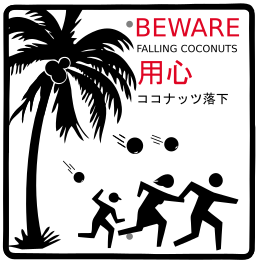
Are 150 people killed each year by falling coconuts?

020719.gif


During a recent ABC television report about how infrequent shark attacks really are, we were told, "Each year coconuts falling from trees kill 150 people." That sounded absurd to me. Could it be true? If so, what is the cause of death?

— Nicki F.

Cecil replies:

This has gone on long enough. It's about time somebody spoke up for the coconuts.

For 20 years scientists have been saying you have a better chance of getting killed by a falling coconut than by whatever lethal life form they were getting big bucks to study. In 1984, for example, this column quoted Dr. Merlin Tuttle, curator of mammals at the Milwaukee Public Museum and founder of Bat Conservation International, on the chances of being bitten by a bat versus death due to various misadventures (getting poisoned at a church picnic, murdered by your spouse, or bitten by a rabid dog or cat). Having worked up a head of steam, Dr. Tuttle thundered, "Statistically, you have a better chance in this country of dying from being hit on the head with a coconut than from a bat biting you."


http://www.straightdope.com/columns/read/2405/are-150-people-killed-each-year-by-falling-coconuts


Death by coconut - Wikipedia

Coconuts can cause death, typically as a result of the fruit falling from trees and striking people on the head. Following a 1984 study on "Injuries Due to Falling Coconuts", exaggerated claims spread concerning the numbers of deaths by coconut. A few people a year have become a widely circulated urban legend. The legend gained momentum after a noted expert on shark attacks claimed in 2002 that falling coconuts kill 150 people worldwide each year.[1] The claim has often been compared with the number of shark-caused deaths per year, which is approximately five.[2]


260px-BEWARE_FALLING_COCONUTS_sign_in_Honolulu_Hawaii-Vector.svg.png
150px-Coconuts_on_Tree_4.jpg
300px-Coconut_distribution.png


https://en.wikipedia.org/wiki/Death_by_coconut


Falling Coconuts Kill More People Than Shark Attacks

"Falling coconuts kill 150 people worldwide each year, 15 times the number of fatalities attributable to sharks," said George Burgess, Director of the University of Florida's International Shark Attack File and a noted shark researcher.
"The reality is that, on the list of potential dangers encountered in aquatic recreation, sharks are right at the bottom of the list," said Burgess who was one of three scientists participating Tuesday in a National Sea Grant College Program and NOAA Fisheries sponsored press briefing on sharks and the risks of shark attacks at the National Press Club

http://unisci.com/stories/20022/0523024.htm

courtey from Bill, in conversatuon with ..
 
The Squirrel in the Park
0OIjt04w0FbmOJTXkyNcp7Juuuu9RcfxrW2H_gQP3KQ09WT2ibngQHwmOgowP4NCfO5vppa6LZmlO0Dm79m96btRUR9XsSXIhJjF_jhRoZXO94SmzE9NKwk6SW6K5TQzA_6NVrt8mYcirPOEXncCX_dVnp6vzzGgKsXbDIA=s0-d-e1-ft
Pictured above is a squirrel. The squirrel is in Manhattan’s Central Park, an expansive natural escape in the middle of one of the world’s most prominent cities. Central Park has lots of squirrels -- certainly too many to count. (As of 2012,per the New York Times, "no formal census [was] being considered.) But… how did all those squirrels get there? And why?

Because they’re exotic. Or, were.

Central Park is, unsurprisingly, located in the middle of Manhattan. On all four sides, the park is bound by Manhattan’s well-travelled roadways, filled with cars and bikes and pedestrians -- hardly a hospitable environment for a squirrel. While it’s possible that the first squirrel (or squirrels, as it takes at least two to start a population) crossed 59th Street, found itself some acorns, and made itself a cozy little home, that creates a second problem: how’d it get to 59th Street in the first place? Manhattan is an island and, while squirrels can swim, it’d be quite the effort. And no, Central Park’s squirrels don't predate Central Park.

Squirrels are indigenous to North America and, in the early 1800s, were common on the island of Manhattan. The rapid development of the city proved to be incompatible with any efforts (of which there weren’t any) to maintain the rodents’ habitat, though. By the 1850s, squirrels were quite rare in Manhattan, so much so that in 1856 -- a year before Central Park’s founding -- one of them literally stopped traffic. New York magazine relays an account from the now-defunct New York Daily Times when passersby happened upon a squirrel: "The appearance of an 'unusual visitor' in a downtown tree attracted hundreds of cheering rubberneckers, who had to be dispersed by cops."

New Yorkers were hardly alone in their enraptured love of this "new" creature. Gizmodo expands on the popularity of the squirrel and its novelty:Around the same time, a sea change in our relationship with squirrels was already underway in Philadelphia. The city had released three squirrels in Franklin Square in 1847 and had provided them with food and boxes for shelter—and the people loved it. One visitor is quoted as saying "it was a wonder that [squirrels] are not in the public parks of all great cities." In the years that followed, the trend spread to Boston and New Haven, where squirrels soon grew so fat from humans feeding them that they were falling out of the trees. Cities even started planting nut-bearing trees so that the squirrels would have their own food source.New York itself was soon to follow. In 1877, the city imported a few dozen pairs of squirrels into the park, gave out peanuts to parkgoers so they could feed the creatures, and even provided housing in the form of nesting boxes. (Those are basically bird houses, but for squirrels. Here are a few on Amazon, if you want to see the pictures.) As one would correctly guess, the squirrel population boomed, and -- despite that lack of a formal census -- Central Park found itself with way, way more squirrels than anyone intended.

So in 1883, again per New York magazine, "the city organize[d] a series of early-morning squirrel hunts for population control." The ASPCA and others objected, but those objections didn't matter -- the squirrels were going to win anyway, as their numbers were simply too high for such an informal method of culling its numbers. Ultimately, hunting squirrels became illegal. Instead, communities -- Central Park included -- began to see the act of feeding the squirrels as a simple way for people to connect with nature. As Gizmodo simply sums it up: "they were put there to remind us of how man and nature must get along, even if it takes a little effort."

addit,unrelated hha
gossip columnistme ..

AxDQo1bYf7SuB47OfjCijdHzw7gjM-qPB3dKqXg8RKlcCcN-tWAs_OEg4pIVqB62zvZe8fsWvzcZ_rUn8QuLaq9WXdQ=s0-d-e1-ft
Richard Jenkins, better known by his stage name Richard Burton, was a dark, introspective actor who specialized in portraying conflicted men. His tempestuous marriage to Elizabeth Taylor led to an acting partnership that vaulted Burton to the top rank of stardom. Together they made 11 films, including Cleopatra and The Taming of the Shrew. Burton and Taylor were married twice, and their real-life marriage was popularly likened to the fictional marriage they portrayed in what film?
More...
 
Why Do Koalas Spend Their Days Hugging Trees?

apparently
pondering,if this could be a truth
and,the next sceintific theory due in about 2035

AAiXy4e.img


Research suggests that koalas spend so much time hugging trees because it
keeps them cool.
Why do koalas turn into tree huggers during Australia’s hot summer
months? A June 2014 study published in the journal Biology Letters found
that koalas move to the lower parts of a tree and press their bodies close
to the trunk in order to cool down. The temperature of the tree trunks, the
University of Melbourne researchers found, was several degrees cooler than
the air temperature on the hottest days of summer.
 
apparently
theres Flall lekelihood of seeing this bloody super moon in NZ anyway bugger
..

Related to the below: This Saturday is World Toilet Day, a very serious event in international public health circles, despite the word "toilet." I tried to work it into today's story but didn't do a great job there, so, I'm using this space for that. If you want to learn more about World Toilet Day, click the link. -- Dan
A Def Vacation
The South Korean city of Suwon is home to over a million people, making it one of the nation's ten most populous municipalities. According to Wikipedia, it's most notable tourist attraction is Hwaseong Fortress, a structure dating back to the late 1700s, the remains of which are a UNESCO World Heritage site. But that's hardly Suwon's only attraction.

There's also this:
jmB61ryNMZySMFPq3kgAZENEDNGh8DW2xMq3cwza1wkkHTyJHJMFtmClf3rElGeZxI40JtXcC73o6JVQWtXGaReE4AKmAwhZUs-lXWl6tze58AOCiRncgXxLdcAcTw6PfdwkqepFlWC1JbfeGQbHJLSuAnWel8RlTMq-hlY=s0-d-e1-ft
That's a museum called 해우재, or Haewoojae, which according to the Korea Tourism Organization, translates to "a house to relieve one's concerns." And if it looks kind of like a toilet, there's a reason for that:

It's a museum dedicated to toilets.

Colloquially, in English, the attraction is called "Mr. Toilet House." It's the brainchild of Sim Jae-duck, a former mayor of Suwon who was "known as Mr Toilet thanks to his efforts to improve the city toilets at the 2002 World Cup during his tenure"according to the BBC. (Per Kotaku, quoting a YouTube commenter -- but it's probably true -- "Korea's public toilets were 'ramshackle and disgusting' before the 1980s.") Mr. Sim built himself the toilet-shaped home in 2007 and, after his death, the city turned it into a museum reflecting his life's work. The exhibits, such as the ones seen below, focus on the culture of pooping.

BxESr6YiDrjqCMQIPFQ9YcriqnlAFUxmRMgnmBwnizaoay0aYholphUBeTBWlNhjluuBDM-ap-3M_SS6dn33kEee1Lkqq-bwZ8Lgq8s9SCX8JKxgDbPH_MCrw73_buC6Bm1sXXWcLuBfz53j3BHlbwfNXKrti6kZUJIWpt8=s0-d-e1-ft

MWoFul6G0eh3c_fWN5uiF0e2Do1_rYNJWc5d_BDtxZjOe0lwAztzCar6VZX0Do6TFRnM3pR4qLcOdVCW9YthoLFgsZAchp1dOYXsMZqXfmIwviBBx5et1aJdhNLfLAz92_Le8h-OIXYT6c-UFptD99W9EpX-m4FVS0usspY=s0-d-e1-ft
Fun stuff.

But really, the museum is no laughing matter. As previously noted in these pages,per the Centers for Disease Control, "eighty-eight percent of diarrhea cases worldwide are linked to unsafe water, inadequate sanitation or insufficient hygiene. These cases result in 1.5 million deaths each year, mostly in young children." Mr. Sim was well aware of this; he founded the World Toilet Associationto help address these concerns. (The much larger World Toilet Organizationaddresses the same.) Mr. Toilet House isn't a joke -- it's an effort to raise awareness around this critical public health concern.

And it's been somewhat successful -- the museum's reviews on TripAdvisor aregenerally positive and per Reuters, roughly 40,000 people visited the attraction in its first four months. Admission to the museum is free, in case you'd like to judge for yourself. But as getting there can be pricey unless you live in the area, you're [you know what] out of luck unless you can afford the airfare. Your best alternative?Here's a video by the BBC, taking you through some of the high points of the experience.
 
apparently
not such good news for this Koala ..

Can a koala bear being harassed by a currawong?

A currawong is caught on video repeatedly harassing a koala in broad daylight as the marsupial tries to snooze.


http://www.abc.net.au/news/2016-11-16/currawong-harasses-sleepy-koala/8030340?WT.mc_id=newsmail


Why Do People Become Friends?

apparently

Research shows that people have more DNA in common with their friends than
with strangers.

It's said that friends are the family you choose, and a 2014 study by
researchers from Yale University and the University of California at San
Diego found that there is more truth to that statement than you might
think. The research, which studied an ethnically homogeneous group of
individuals, found that people unknowingly choose close friends who have
DNA sequences in common. An analysis of 1.5 million markers of gene
variations found that pairs of friends tend to have the same level of
genetic relation as people do with their fourth cousins, or a
great-great-great grandfather
 
Over 100 rentals abandoned after the earthquake

apparently
we in NZ are not as bad as the young Dutch tourist portrayed us to be, when he was stranded for 4 days in a remote NZ country town?? ha
the perils of hitchhiking, you live with it??


1479282657545.jpg


More than 100 stranded drivers who abandoned their rental cars around Kaikoura after the earthquake may have to help pay the costs to retrieve the vehicles.

Rental companies are not sure how the recovery process will work, but some are saying if costs are not covered by a customer's travel insurance, they could be footing the bill themselves.

However, operators are not charging for extra rental days caused by the quake. They are also offering customers replacement vehicles where possible, so travellers can continue their holidays.

This is straining resources coming into the busy summer season, as evacuated customers effectively had two vehicles each while their initial one sat abandoned in Kaikoura.

http://www.stuff.co.nz/national/nz-...ke?cid=edm:stuff:dailyheadlines&bid=123138982
 
apparently

of course we pseudo intellectuals all well know of the King James version huh duh
or at least ..
well we can play pretend,using the bs medium if a bc site

The Forbidden Experiment
zA56e-Ez_vkg2OtqW1nIRL9u1U05mSM_xcIaDffnCZg2ahmWhF1NwKtjMEtGC2h_YJC0AHRuPGjDcYHomtc4mvEHDntxsj5onJn3RWaB05tQ_P86LhDxPDuZOHcRL4DuPZ52ZA9wrQlLwvgs5Kl2QvZuhcAYvnyfskuXlis=s0-d-e1-ft
This sentence is written in a language called English. Even though these words are made up of seemingly random marks arranged in odd shapes, you can understand it. And for many, that ability seems almost innate: if you’re a native English speaker, you seemed to have picked up a lot of your comprehension of the language seemingly organically and, to a large degree, in a way beyond your memory’s reach.

But it's not actually innate -- we obtain our first language(s) from observing our surroundings when we are very young. So, what would have happened if you weren’t exposed to a language -- any language -- at that point in your life? What would have happened instead?

We’ll probably never know -- because to find out would require that a newborn is brought up in silent isolation, which most everyone today would find inhumane. In fact (in the context of a feral child), an author named Roger Shattuck coined such an endeavor “The Forbidden Experiment” for this very reason.

And yet, in the past, some have tried it anyway -- with King James IV of Scotland leading the way.

By all accounts, King James IV was a polyglot -- he spoke at least a half-dozen different languages. And the king wanted a deeper understanding of how we communicated, but in a biblical sense; he wanted to know what language Adam and Eve spoke. The two, per the Bible, were able to speak with one another, but the two predated any other human and therefore any other spoken tongue. Logically, the theory goes, Adam and Eve’s ability to communicate had to be something they were born with, not something they learned. And James IV wanted to know what that innate language sounded like.

Enter the tiny Scottish island of Inchkeith, flagged in the map above. Located in theFirth of Forth, the estuary of a river which dumps into the North Sea, the island has a storied history despite -- or perhaps because of -- the fact that it's not (typically) populated. In this case, King James IV (probably -- there's a small but meaningful chance that the tale is a myth) "had a deaf and dumb woman transported to the [island] with two infant children," per the BBC. The BBC continues: "She was to nurse the infants until they came to the age of speech. It was hoped that when the children learned to speak, free from normal human communication, they would reveal the original tongue - the language of the gods."

So, what happened? We don't exactly know. The first recorded recounting of the events at Inchkeith came 100 years later, and, per Mental Floss, states (unreliably) that "some say they could speak Hebrew." That's unlikely, to say the least -- most historians find the claim dubious. There are simply too many reasons the doubt it: the timing of the report, the third-hand nature of it, the fact that it's uncorroborated, and the fact that in various other such experiments (which predate James IV and have similar historical problems) don't yield the same result all cast doubt upon it.

As a result, if there is an innate language -- and most likely there isn't one -- we will probably never be able to discover it. (But given the cost of trying, that's a good thing.)

Bonus fact: There are other ways to experiment with language acquisition beyond language deprivation, of course. Just ask d'Armond Speers, a linguist who, during the first three years of his son's life, only spoke to him in a foreign language: Klingon. (His son was exposed to English in many other ways -- the only time the kid was immersed in the language of Kirk's nemeses was when his father was speaking to him directly.) As Gizmodo reported, the kid turned out no worse for the wear; "he's a happy camper without any social scars." Qapla’!

 
New Zealand woman on equal wages.
To view this content we will need your consent to set third party cookies.
For more detailed information, see our cookies page.
 
  • Like
Reactions: BillM and rbkwp
What Happened to Isaac Newton’s Apple Tree?

apparently

A piece of the apple tree that inspired Newton's law of gravity went into
orbit on board the space shuttle Atlantis.


Most of us heard the tale back in grade school: A young Isaac Newton is
sitting under an apple tree, contemplating the mysteries of the universe,
when an apple falls from the tree and hits the young scientist on the head.
That simple event, which has been somewhat embellished over the centuries,
is thought to have provided the inspiration for Newton's law of universal
gravitation. The importance of that event for scientific history was
recognized in 2010, when British-born astronaut Dr. Piers Sellers brought a
4-inch (10 cm) chunk of that original tree and a picture of Newton into
orbit on the space shuttle Atlantis.
 
How Good Are Octopuses at Changing Color?


apparently
a clever little dude
save getting caught by arsehole humans for food
cept deceitful humans will use nets huh


An octopus was observed changing the color of its skin 177 times over the
course of an hour.

The colorful and cunning octopus is a master of disguise. By flexing and
relaxing muscles underneath its skin, this cephalopod activates
color-changing sacs full of pigment, called chromatophores, to change its
appearance very quickly. These sacs can change the strange-looking deep sea
denizens from black to brown, orange, red, or yellow. One scientist
documented an octopus changing the color of its skin 177 times within an
hour.
 
How Great Is It to Be a Musician?

apparently
it can be great to be a musician, plenty of road tgrips, if youi like that stuff, i dop
think Willie Nelson ha
BUT
ypour likely top die earlier???


An Australian study found that, on average, pop and rock musicians die 25
years earlier than non-musicians.

There appears to be a heavy price to pay for musicians traveling the road
to stardom. A 2014 academic study at Sydney University studied the lives
and deaths of 12,665 musicians between 1950 and 2014 -- from rock, pop, and
other musical genres -- and determined that high-profile stars die up to 25
years younger than the average person. Those rock stars who died young are
legendary, from Jimi Hendrix and Janis Joplin to Amy Winehouse and Kurt
Cobain. The study indicated that musicians, particular those in the rock
and pop genres, are more susceptible to accidents, suicide, and homicide,
amounting to as much as a 10 times greater chance than for the general
population.